Key takeaways
- Talking-head video: choose a 24–50mm-equivalent lens. In a small room, 24–35mm gives useful space; 50mm produces a tighter, more compressed look but needs more distance.
- Handheld walking video: choose a stabilized lens or a camera-and-lens combination with coordinated stabilization. A 24–70mm-equivalent zoom is versatile, but stabilization may introduce a crop or occasional wobble.
- Interviews: a 35–85mm-equivalent lens at f/2.8–f/4 gives separation without requiring the subject to sit far from the camera.
- Gimbal work: favor lenses around 300–700g. A heavier zoom can exceed the gimbal’s balance range and make every movement harder.
The best camera lenses are chosen by matching focal length and maximum aperture to your subject, then checking sensor compatibility, stabilization, autofocus, and weight against the way you actually shoot.
Quick picks by shooting situation
| Situation | Best lens type | Useful focal length | Recommended minimum aperture | What matters most |
|---|---|---|---|---|
| Portraits | Bright prime or short telephoto zoom | 50–135mm full-frame equivalent | f/1.8–f/2.8 | Background separation, eye autofocus, flattering perspective |
| Landscapes | Wide-angle zoom or prime | 14–35mm full-frame equivalent | f/2.8–f/4 | Corner sharpness, flare control, low weight |
| Wildlife | Telephoto zoom | 100–600mm full-frame equivalent | f/5.6–f/8 | Reach, autofocus tracking, optical stabilization |
| Video | Standard zoom or constant-aperture prime set | 24–70mm full-frame equivalent | f/2.8–f/4 | Quiet focusing, low focus breathing, smooth manual control |
| Travel | Compact standard zoom | 24–105mm full-frame equivalent | f/4–f/5.6 | Size, versatility, weather resistance, stabilization |
How focal length changes the shot
Focal length controls angle of view and working distance. A 24mm lens shows a broad scene, while an 85mm lens shows a narrower slice and lets you stand farther away from a person. That distance changes perspective: facial features generally look more natural when you photograph a portrait from farther away with a short telephoto lens than when you move close with a very wide lens.

Tamron 17-70mm f/2.8 Di III-A VC RXD Lens for Sony E APS-C Mirrorless Cameras
Included for 'Best Camera Lenses for Every Type of Shot' as a relevant option in this category; details come from the product listing.
View on Amazon
Canon RF28-70mm F2.8 is STM Macro Lens, Black
Included for 'Best Camera Lenses for Every Type of Shot' because the listing specifies Black, details this guide uses to compare options.
View on Amazon
Canon RF50mm F1.8 STM Lens
Included for 'Best Camera Lenses for Every Type of Shot' as a relevant option in this category; details come from the product listing.
View on Amazon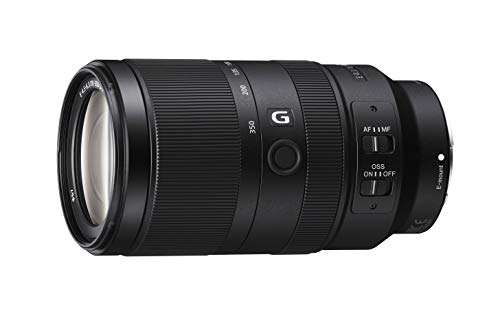
Sony E 70-350mm f/4.5-6.3 G OSS Lens, Telephoto Lens, Black
Included for 'Best Camera Lenses for Every Type of Shot' because the listing specifies Telephoto Lens and Black, details this guide uses to compare options.
View on AmazonOn APS-C cameras, multiply the lens focal length by roughly 1.5 for Sony, Nikon, and Fujifilm bodies, or about 1.6 for Canon APS-C bodies, to estimate its full-frame equivalent. A 50mm lens therefore behaves approximately like a 75–80mm lens on APS-C. Micro Four Thirds cameras use a factor of about 2, so a 25mm lens provides an approximately 50mm-equivalent view.
Portraits: choose flattering reach before maximum blur
For head-and-shoulder portraits, an 85mm-equivalent lens is a dependable starting point. A 50mm-equivalent lens works well for environmental portraits and small rooms, while a 105–135mm-equivalent lens gives more compression and comfortable distance for close-up work.
A wide aperture such as f/1.8 admits more light and can blur the background, but shallow depth of field makes focusing less forgiving. At f/1.8, an eye may be sharp while the far ear is already soft. An f/2.8 or f/4 lens can be easier to use for groups, moving children, and video. Prioritize fast, accurate autofocus if your camera offers face and eye detection.
Landscapes: width, corners, and filter compatibility
A 16–35mm-equivalent lens is flexible for mountains, architecture, interiors, and foreground-heavy compositions. Choose an ultra-wide lens below 20mm when you need dramatic scale, but check distortion and corner performance. Very wide lenses can make nearby objects look enormous and distant features look small, so they reward careful foreground placement.
For landscapes, f/4 is often sufficient because photographers commonly stop down to f/8 or f/11 for depth of field. A lighter f/4 zoom may be a better hiking choice than a heavier f/2.8 model. Check whether the front element accepts ordinary screw-in filters; large bulbous elements may require a more expensive holder system.
Wildlife: reach and handling beat a bright aperture
Wildlife usually demands at least 300mm full-frame equivalent, with 400–600mm giving a much better chance of filling the frame from a respectful distance. A 100–400mm zoom is easier to carry and useful for nearby animals, while a 150–600mm zoom offers more reach but is substantially heavier.
Optical stabilization helps when you are standing still, particularly in dim light, but it does not freeze a moving bird or running animal. Shutter speed remains critical: birds in flight may require around 1/1600 second or faster. A lens with a maximum aperture of f/5.6–f/8 can still work in daylight, but it gives the camera less light for autofocus and may require higher ISO settings.
Before buying a long telephoto, check its total length and weight with the camera attached. A lens weighing 2 kg or more can become uncomfortable within minutes without a monopod, tripod foot, or padded support. A lighter 70–300mm lens may produce more usable photographs simply because you will carry it more often.
Best lens choices for video
Video changes the priorities. A lens that is sharp for still photographs can still be distracting if its autofocus motor is audible or if the image visibly changes size while focusing. Look for quiet linear or stepping-motor autofocus, minimal focus breathing, a constant aperture on zooms, and a focus ring with predictable control.
- Talking-head video: choose a 24–50mm-equivalent lens. In a small room, 24–35mm gives useful space; 50mm produces a tighter, more compressed look but needs more distance.
- Handheld walking video: choose a stabilized lens or a camera-and-lens combination with coordinated stabilization. A 24–70mm-equivalent zoom is versatile, but stabilization may introduce a crop or occasional wobble.
- Interviews: a 35–85mm-equivalent lens at f/2.8–f/4 gives separation without requiring the subject to sit far from the camera.
- Gimbal work: favor lenses around 300–700g. A heavier zoom can exceed the gimbal’s balance range and make every movement harder.
Sensor compatibility: avoid buying the wrong coverage
Full-frame lenses work on full-frame cameras and usually work on APS-C bodies, although the smaller sensor uses only the center of the image circle. APS-C lenses are designed for the smaller sensor and may produce dark corners on a full-frame camera when used in a crop mode. Micro Four Thirds lenses are made for a smaller sensor and are not interchangeable with full-frame systems.
Mount compatibility is separate from sensor coverage. Sony E, Canon RF, Nikon Z, Fujifilm X, and Micro Four Thirds are different mounts. Some third-party lenses are available in several mounts, but an adapter can affect autofocus speed, aperture control, stabilization, or weather sealing. Confirm the exact mount version before ordering.
Stabilization, aperture, and weight: the practical trade-offs
| Lens choice | Typical weight | Main advantage | Main compromise | Best fit |
|---|---|---|---|---|
| 50mm f/1.8 prime | 150–350g | Low cost, strong low-light performance | Fixed composition | Portraits, street photography, everyday carry |
| 24–70mm f/2.8 zoom | 600–950g | Professional versatility and constant brightness | Large and expensive | Events, weddings, video, travel with one lens |
| 16–35mm f/4 zoom | 350–700g | Wide coverage in a relatively manageable package | Less light than an f/2.8 version | Landscapes, architecture, interiors |
| 100–400mm zoom | 1,000–1,600g | Useful wildlife range without extreme bulk | Needs good light at the long end | Outdoor sports and animals |
| 150–600mm zoom | 1,900–2,400g | Long reach at a lower price than many professional primes | Requires support for long sessions | Birds and distant wildlife |
Optical stabilization is especially valuable with telephoto lenses and for static subjects in low light. It is less useful for fast action, where shutter speed matters more. In-body stabilization can complement optical stabilization, but the result varies by camera and lens combination. Do not pay extra for stabilization if you mostly use a fast shutter speed on a tripod, although it can still help with framing a long lens.
A simple buying process
- List your two most common subjects. A lens for occasional wildlife should not dictate the size of an everyday kit.
- Choose the equivalent focal-length range. Convert for your sensor before comparing lenses.
- Set a minimum aperture. Choose f/1.8–f/2.8 for frequent low-light work, or f/4–f/8 when daylight, depth of field, and low weight matter more.
- Check the complete carrying weight. Add the lens, camera body, battery, and support. A 900g lens can become a 1.5kg setup after accessories.
- Confirm practical features. Check stabilization, autofocus noise, weather sealing, filter size, minimum focus distance, and whether the zoom turns in the correct direction for your workflow.
- Buy for your transport habits. If the lens cannot fit your camera bag or is uncomfortable on a full-day walk, its specifications will not help you make better photographs.
Bottom line
Choose a bright 50mm or 85mm-equivalent prime for portraits, a 16–35mm-equivalent lens for landscapes, a stabilized 100–400mm or 150–600mm zoom for wildlife, and a quiet, stabilized 24–70mm-equivalent zoom for general video. The best camera lenses are not necessarily the sharpest or brightest models; they are the ones whose focal length, aperture, sensor coverage, stabilization, and weight fit the shots you can realistically make.