Our Top Picks
For long sessions, the chair that adjusts to your body beats the chair with the better name, and that usually means a well-equipped ergonomic office chair. A gaming chair can still be a sound choice when it has a real lumbar adjustment, adjustable armrests and a seat you can size to your legs, but a racing-style shell with a loose pillow is a weaker bet at hour five. This guide covers what separates the two categories, how to check fit with a tape measure and a floor, and how three example products fit different situations.
Quick Verdict
| Your situation | Our verdict |
|---|---|
| You sit four or more hours a day for work and play | Prioritize adjustability: height, seat depth, lumbar height and armrests. An office-style ergonomic chair is the safer default, and a gaming chair is fine only if it offers these controls. |
| You mostly game in sessions of two hours or less | A gaming chair is reasonable. Recline range and a headrest matter more here than fine-tuned task adjustments. |
| Your current chair is fine except for lower-back fatigue | Try a lumbar support cushion before replacing the whole chair, and check that it sits at the small of your back rather than your mid-back. |
| You like to lean back, put your feet up and use a controller | A gaming chair with a wide recline and a retractable footrest suits that style better than most task chairs. |
| You share the chair with someone of a different height | Choose the model with the widest seat-height and armrest range, and avoid fixed bolsters that lock one body shape in. |
The Key Differences
The labels “gaming” and “office” describe marketing categories more than engineering ones. Chairs in both groups range from basic to highly adjustable, so the useful comparison is feature by feature. The guidance below leans on the U.S. Occupational Safety and Health Administration (OSHA) computer workstation guidance, which describes what a seated workstation should allow rather than endorsing a chair style.

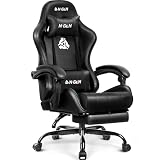
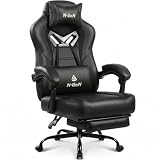
N-GEN GAMING Gaming Chair with Footrest, Lumbar, High-Back, All Black | Reclining Backrest, Linkage Armrests, Durable PU Leather, Adjustable Comfort for Extended Computer, Desk, or Home Office Use
Chosen because it specifies Lumbar and High-Back.
View on Amazon
Lumbar Support Pillow for Office Chair, Office Home Essentials,Gifts for Mom,Dad, Back Support Pillow for Car, Chair Cushions,Back Pain Relief Improve Posture,Mesh Cover Double Adjustable Straps
Chosen because it specifies Office Home Essentials and Gifts for Mom.
View on Amazon
GTPLAYER Gaming Chair, Computer Chair with Footrest and Lumbar Support, Height Adjustable Game Chair with 360°-Swivel Seat and Headrest and for Office or Gaming (Pearl White)
Chosen because it specifies Computer Chair with Footrest and Lumbar Support.
View on AmazonBack shape and lumbar support
OSHA guidance says a chair backrest should fit the natural curve of the spine and that the lumbar support should be height-adjustable so it lands in the small of your back. Many gaming chairs ship with a strap-on lumbar pillow and a neck pillow. That can work, but a strap-on pillow shifts, and its height is whatever you set it to on the strap. Task chairs designed around ergonomics usually build the lumbar support into the backrest and let you move it up or down. Neither design is automatically better; what matters is whether the support can sit at the right height for your torso length.
Seat depth and thigh support
Seat depth is the adjustment most often missing from entry-level chairs of both types. OSHA guidance says the seat should support most of the thigh without the front edge pressing behind the knee. If the seat is too deep, you either slouch away from the backrest or the edge cuts into the back of your knees. Many task chairs offer a sliding seat pan. Many gaming chairs have a fixed seat, so you are relying on the chair already matching your leg length. Check the seat dimensions on the listing, and if the seat depth is not stated, treat the chair as non-adjustable.
Armrests, recline and changing posture
Armrests should support the forearms with the shoulders relaxed and the elbows near your sides. A chair whose armrests only move up and down is workable for some desks, but height, width and pivot adjustment give you more room to match your keyboard and mouse. Linked armrests that follow the backrest, as on some gaming chairs, help in recline but do not replace independent adjustment at the desk.
OSHA’s posture guidance says that sitting still for long periods is not healthy and lists several acceptable neutral postures: upright sitting, standing, declined sitting, and reclined sitting with the torso at roughly 105 to 120 degrees from the thighs. It also states the backrest should recline at least 15 degrees from vertical. That is a point in favor of chairs with a wide, lockable recline, which many gaming chairs offer, as long as the backrest still supports your back while reclined.
Materials, heat and durability claims
Most gaming chairs use PU leather over foam. It wipes clean, but it does not breathe the way mesh or fabric does, and long sessions in a warm room can feel sticky. Many office chairs offer mesh backs for that reason. On durability, the relevant U.S. standard is ANSI/BIFMA X5.1 for general-purpose office chairs, which covers strength, stability and cyclic durability testing. It does not rate comfort or ergonomics, and a “BIFMA tested” phrase on a listing is not the same as a certificate you can look up. Treat such claims as something to confirm, not a guarantee.
| Feature | Typical gaming chair | Typical ergonomic office chair | What to check |
|---|---|---|---|
| Lumbar support | Strap-on pillow, often fixed shape | Built-in, often height-adjustable | Can it sit at the small of your back? |
| Seat depth adjustment | Often absent | Common on mid-range and up | Space between seat edge and the back of your knee |
| Armrest adjustment | Height only, or linked to recline | Height, width and pivot on better models | Elbows near 90 degrees, shoulders relaxed |
| Recline range | Wide, often up to 135 degrees on listings | Moderate, often with tension control | Backrest supports you at your preferred angle |
| Upholstery | PU leather common | Mesh or fabric common | Room temperature and session length |
| Footrest | Sometimes built in | Rare, usually a separate item | Feet flat on the floor or a stable footrest |
The table describes typical patterns, not every model. Some gaming chairs include excellent adjustment and some office chairs skimp, so the listing details for the exact chair always take priority.
How to Decide
Use this checklist before you compare brands. Each point can be measured at home.
- Feet and knees. Sit with your whole sole on the floor and the back of the knee slightly higher than the seat, which is the OSHA description of an appropriate seat height. If your feet dangle at the lowest setting, the chair is too tall for you or the desk needs a footrest.
- Seat edge gap. With your back against the backrest, you should be able to slide a couple of fingers between the front of the seat and the back of your knee. This is a common fitting rule of thumb, not a standard. If the seat is fixed and the gap is gone, the chair is too deep for you.
- Elbow height. With the chair at the right height, your forearms should rest on the armrests or desk with the elbows near 90 degrees. Measure your desk height and compare it with the chair’s armrest range on the listing.
- Lumbar position. Reach behind your back and find the inward curve above your belt line. The support should meet that curve. If the pillow or built-in support sits higher at its lowest setting, it will push on your mid-back.
- Recline plan. Decide how much you lean back while playing. If you spend most of your time upright at a keyboard, a wide recline matters less than lumbar and armrest range. If you play with a controller on a couch-style posture, recline matters more.
- Weight and size limits. Compare the listed weight capacity and seat width with your body. Rules of thumb vary, but leave a margin below the stated capacity rather than sitting at the limit.
- Break schedule. No chair removes the need to change position. OSHA guidance recommends changing posture and standing periodically, so plan short breaks regardless of the chair you choose.
A worked example: suppose your desk is at a typical fixed height and you are tall. The chair’s top seat height may leave your knees below your hips, which is fine, but a short backrest may stop above your shoulder blades. For that body shape, backrest height and headrest position become the limiting specs, not recline. A shorter person has the opposite problem, where the lowest seat height may still leave the feet off the floor. In both cases the answer comes from measuring, not from the chair category.
Products That Fit
The products below are examples that match the situations above, not a ranking. Specifications come from the listing fields; where a detail is not listed, confirm it on the product page before buying.
N-GEN Gaming Chair with Footrest – suits recline and lounge-style players
As an Amazon Associate we earn from qualifying purchases at no extra cost to you.

This one fits the player who leans back, puts their feet up and wants armrests that follow the backrest. The listing describes a backrest that adjusts from 90 to 135 degrees, which comfortably covers the 105 to 120 degree reclined posture OSHA lists as acceptable. It also includes lumbar and neck cushions and a retractable footrest, which suit controller-based sessions.
- Reclining backrest listed at 90 to 135 degrees with linkage armrests
- Retractable footrest, lumbar cushion and neck cushion
- PU leather over high-density foam, steel frame and an SGS-certified gas lift per the listing
- Listed dimensions 27.5 x 24.5 x 46.5 inches and weight 37.48 pounds; seat depth and weight capacity are not in the cached fields, so confirm on the listing
Caveat: linked armrests move with the backrest, so they may not be independently adjustable for width or pivot at a keyboard. A built-in footrest also does not replace a floor-level foot position during desk work.
Lumbar Support Pillow for Office Chair – suits an existing chair that only fails at the lower back

This is not a chair, so it fits a different situation: you already own a chair you like and the problem is the curve of your lower back. A cushion costs little compared with a new chair and lets you test whether added lumbar support helps before you commit to a replacement. It is also listed for car seats, so it can travel between uses.
- Back support pillow format intended for office chairs and car seats
- Listing positions it for lower-back comfort; material and fill details are not in the cached fields, so confirm on the listing
- Strap or fastening style: confirm on the listing
- Dimensions and thickness: confirm on the listing
Caveat: a pillow cannot fix a seat that is too deep, armrests at the wrong height or a desk that forces you to shrug. It addresses one adjustment only, and if the cushion sits too high or too thick it can push you forward away from the backrest.
GTPLAYER Gaming Chair with Footrest and Headrest – suits an all-in-one desk and lounge setup

This model suits a player who wants a headrest, a lumbar pillow and a footrest in one package, and who sits in a mix of upright and reclined positions. The listing highlights metal legs rather than plastic, padded armrests and a height-adjustable seat with 360-degree swivel. That makes it a workable pick for mixed work and play sessions of moderate length, with the usual caution about PU leather in warm rooms.
- Headrest and lumbar pillow included, with a pull-out footrest
- Metal legs and padded armrests as described in the listing
- Height-adjustable seat with 360-degree swivel
- Listed weight 40.56 pounds in Pearl White; recline range and seat depth are not in the cached fields, so confirm on the listing
Caveat: the description does not state a seat depth adjustment or a lumbar height range, which are the two controls that matter most at hour five. Check those before relying on it for full workdays.
Common Mistakes
- Buying on category name instead of adjustment list. A chair labeled ergonomic with no lumbar or armrest range can be worse than a gaming chair that has both.
- Using the maximum seat height regardless of desk height. The goal is feet flat and elbows near 90 degrees, not the highest setting.
- Strapping a pillow high on the backrest. Lumbar support belongs at the small of the back, above the belt line, not behind the shoulder blades.
- Assuming recline fixes posture. Leaning back helps only if the backrest continues to support you, and OSHA still recommends changing position through the day.
- Trusting a durability phrase without a source. A “tested to BIFMA” phrase is not the same as a report you can verify, and the standard does not rate comfort.
- Ignoring room temperature. PU leather holds heat, so a long session in a warm room can undo the comfort of good padding.
Questions
Is a gaming chair bad for your back?
Not inherently. The risk comes from fixed shapes and strap-on pillows that do not match your spine, plus sitting still for hours. A gaming chair with adjustable lumbar height, a usable seat depth and adjustable armrests can be as comfortable as an office chair, and posture variation still matters.
How many hours is too long to sit in one go?
OSHA guidance does not set a single number. It says sitting still for prolonged periods is not healthy and advises changing positions frequently, standing periodically and stretching. A practical habit is to stand or walk briefly between matches or tasks rather than waiting for discomfort.
Do I need a headrest?
Not for desk work, where the head is usually forward of the backrest anyway. A headrest helps when you recline for video, console play or breaks. If you rarely lean back, spend your budget on seat depth, lumbar adjustment and armrests first.
Is a footrest on a chair useful at a desk?
OSHA guidance says feet should rest flat on the floor or on a footrest. A built-in footrest suits reclined, relaxed sitting, but for typing you generally want your feet on the floor with your knees at a comfortable angle. If your feet do not reach the floor, a separate stable footrest is the more appropriate fix.
Can a lumbar pillow replace a better chair?
It can help when lower-back support is the only gap. It cannot correct seat depth, seat height or armrest problems, and a thick pillow on a deep seat can push you off the backrest. Treat it as a trial before replacing the chair, not a cure.
What does a BIFMA mention on a listing mean?
ANSI/BIFMA X5.1 is a U.S. standard for the strength, stability and durability of general-purpose office chairs. It does not measure comfort or ergonomic fit, and it is not by itself a product certificate. If a listing cites it, look for the specific model and edition before treating it as proof.
Update History
- October 14, 2026 – Initial publication.
- Check the product page for current specifications and availability before buying.
Sources and Methodology
This article compares chair categories using published workstation guidance and the retailer listing fields for the example products. No chair was physically evaluated for this guide. Product specifications are quoted from listing text and flagged where a field was missing.
- OSHA Computer Workstations eTool, chair and working-posture pages
- ANSI/BIFMA X5.1 standard summaries from standards and testing organizations
- Retailer listing fields for the three example products
- Furniture-maker and retailer comparison articles, used only for general category patterns