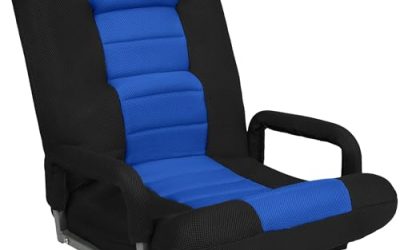
Finding a big and tall office chair with footrest for higher-weight users requires more attention to fit, construction, and weight capacity than shopping for a standard desk chair. A chair advertised as supporting 500 pounds may still have a narrow seat, restrictive armrests, or a footrest that provides limited leg support. The best choice should accommodate the user’s seated measurements, provide an appropriate weight rating, and support comfortable positioning during both work and reclining. This guide explains which specifications matter, how to evaluate built-in footrests, and when a separate heavy-duty chair and footrest may be a better investment.
What to look for in a high-capacity office chair
The most important purchasing consideration is whether the chair accommodates your body comfortably while staying within its manufacturer’s weight limit. A high weight rating alone does not establish that a chair will fit properly.
Start with these five specifications:
| Feature | What to look for | Why it matters |
|---|---|---|
| Weight capacity | A clearly stated manufacturer limit above the user’s weight | Establishes the chair’s stated load limit |
| Usable seat width | Enough clearance between armrests for comfortable sitting | Prevents restrictive positioning |
| Seat depth | Sufficient support for the thighs without pressure behind the knees | Improves seating fit |
| Frame and base | Reinforced construction and a sturdy five-leg base | Important for stability and durability |
| Footrest | Adequate length, width, and extension for the user’s legs | Determines whether the feature is genuinely useful |
Do not prioritize decorative features such as RGB lighting, massage functions, or oversized headrests before checking these basic requirements.
Choose a weight capacity that matches your requirements
Weight capacity should be one of the first specifications you check.
Many ordinary office chairs are designed around relatively modest user-weight limits. Higher-capacity models may advertise ratings of 400, 500, or 600 pounds, while specialized bariatric seating can support still higher loads.
A useful starting point is to compare the manufacturer’s maximum recommended user weight with the intended user’s current weight.
| Advertised capacity | General purchasing consideration |
|---|---|
| 300 lb | Standard or moderately reinforced seating |
| 400 lb | Higher-capacity office seating |
| 500 lb | Heavy-duty big and tall seating |
| 600 lb | Specialized high-capacity seating |
| Above 600 lb | Specialized bariatric or custom seating may be necessary |
These categories describe advertised limits, not independent certifications or guarantees of durability.
For example, Husky Seating’s Multi-Shift 24/7 chair (item 53654) has a manufacturer-listed 500-pound capacity. Its specifications include a 25.5-inch-wide seat and a 22-inch seat depth. By comparison, Bariatrics Unlimited lists a specialized PCB-2503 computer chair with a 600-pound capacity.
The important distinction is that a 500-pound chair is not an appropriate substitute for a chair rated above 500 pounds. Do not exceed the manufacturer’s specified capacity, even if the frame appears unusually sturdy.
Also check whether the stated limit applies to the complete chair rather than an individual component. A reinforced seat does not establish that the gas lift, reclining mechanism, base, and casters have the same capacity.
Understand large-occupant chair standards
Weight ratings are useful, but independent safety and performance standards provide another way to evaluate office seating.
One relevant standard is ANSI/BIFMA X5.11, which covers general-purpose large-occupant office chairs. The standard uses a 400-pound user-weight basis for its testing requirements. Its dimensional provisions were developed specifically for large-occupant seating, including a minimum seat width of 22 inches.
This standard is particularly relevant when comparing chairs advertised for larger users because it addresses more than an ordinary marketing claim about maximum weight.
However, there is an important distinction:
-
A manufacturer advertising a 500-pound capacity is making a product-specific capacity claim.
-
A chair meeting ANSI/BIFMA X5.11 has been evaluated against a large-occupant office-chair standard.
-
A chair should not be described as BIFMA-compliant merely because its listing mentions heavy-duty construction.
Look for a specific standard designation, a verifiable product listing in BIFMA’s compliance registry, or appropriate test documentation. Ask the manufacturer for clarification when these details are missing.
How to choose a big and tall office chair with footrest
A chair can meet its advertised weight capacity and still be uncomfortable if its seat, armrests, or footrest do not match the user’s measurements.
The best approach is to evaluate the chair as a complete seating system rather than focusing on the weight number or the presence of a retractable footrest.
Measure the usable seat width and armrest clearance
Seat width is particularly important when choosing an office chair for a larger body.
Manufacturers may publish the width of the upholstered seat, but that measurement does not necessarily represent the actual sitting space between the armrests.
For example, a chair might have a relatively wide cushion while fixed armrests make the usable area noticeably narrower.
Before ordering, check three measurements:
-
The width of your hips and thighs while seated in a natural position.
-
The clear distance between the inside edges of the armrests.
-
The total seat cushion width, including any raised side bolsters.
Allow enough room to sit down, shift position, and stand up without repeatedly contacting the armrests.
Removable or adjustable armrests can be useful when additional clearance is needed. However, removing the arms should only be considered when the manufacturer permits it and confirms that doing so does not compromise the intended use of the chair.
Also remember that a wider seat is not automatically better. The chair must still provide suitable back support and allow the user to reach the desk without leaning forward.
Check seat depth and height for proper leg support
Seat depth determines how much of the thighs the cushion supports.
A seat that is too short may leave too much of the thighs unsupported. A seat that is too deep can press against the back of the knees or make it difficult to maintain contact with the backrest.
A useful measurement is the distance from the back of the hips to the area just behind the knees while sitting. Compare this with the actual seat depth, taking the back cushion into account.
Seat height is equally important.
If the seat is too high, the feet may not rest comfortably on the floor. If it is too low, the knees may rise significantly relative to the hips, which can change how the body contacts the seat.
OSHA’s computer workstation guidance recommends adjusting seat height so the feet are supported by the floor or a footrest, with appropriate support for the thighs and lower back.
Pay particular attention to thick seat cushions. The advertised seat height is typically measured before a person sits down, so the height under load may differ.
For taller buyers, confirm that the backrest provides adequate upper-back support and that the seat depth accommodates longer thighs. For shorter buyers, avoid chairs with excessively deep cushions that prevent comfortable backrest contact.
Evaluate the built-in footrest carefully
A footrest can make an office chair more versatile, especially when you want to recline during breaks.
However, built-in footrests on inexpensive executive and gaming-style chairs are not always large enough to support the entire lower leg.
Check the following:
-
Actual footrest width and length.
-
Maximum extension distance.
-
Whether it slides out smoothly.
-
Whether it remains stable when extended.
-
Whether it moves with the reclining backrest.
-
Whether your feet and lower legs remain supported in the reclined position.
For example, the KERDOM 500-pound reclining chair listed by Target specifies a 13.8-by-8.3-inch footrest. Its listed seat measures approximately 20.9 inches wide by 19.7 inches deep.
These measurements illustrate why the phrase “built-in footrest” is insufficient when comparing models. A compact footrest may support the feet in a relaxed position without providing the broader lower-leg support some users expect.
Do not assume that a footrest is suitable for supporting the full weight of your lower legs simply because it is attached to a heavy-duty chair. Check the manufacturer’s operating instructions and intended use.
Consider a separate footrest if the chair itself is the priority
One of the most useful alternatives is to purchase a properly sized heavy-duty office chair and pair it with a separate floor footrest.
This arrangement allows you to prioritize seat dimensions, frame capacity, and back support without restricting your choice to chairs with retractable footrests.
Husky Seating’s Multi-Shift 24/7 chair is an example of this trade-off. Its manufacturer lists:
| Specification | Listed measurement |
|---|---|
| Weight capacity | 500 lb |
| Seat width | 25.5 inches |
| Seat depth | 22 inches |
| Seat height | 18–22 inches |
| Overall width | 32 inches |
| Warranty | 1-year limited |
It does not have an integrated footrest. However, its larger published seat dimensions may make it worth comparing with narrower reclining models.
A separate footrest also lets you select a platform with a more appropriate width and height. Make sure it remains stable, does not slide across the floor, and does not interfere with your chair or desk.
The trade-off is additional floor space and another item to purchase.
Important construction features to inspect
A high-capacity office chair needs more than a wide cushion. Its structural components must be appropriate for the manufacturer’s stated weight limit and intended use.
Frame, seat support, and base
Look for a reinforced frame, a properly supported seat pan, and a sturdy five-leg base.
Metal frames and reinforced seat structures are common in heavy-duty seating, but material descriptions alone do not establish quality. The thickness, design, connection points, and construction of the complete chair matter.
Pay attention to the following components:
| Component | What to check |
|---|---|
| Frame | Reinforced construction and secure connections |
| Seat pan | Support structure appropriate for the advertised capacity |
| Base | Sturdy five-leg design with suitable load specifications |
| Casters | Manufacturer-approved wheels for the chair and floor surface |
| Reclining mechanism | Documented capacity and secure locking positions |
| Gas lift | Suitable rating and compatibility with the chair |
Avoid assuming that a Class 4 gas lift automatically means a chair is safe for 500 pounds. The rating of one component does not establish the capacity of the complete chair.
The same applies to metal bases. A steel base can still be poorly matched to the seat mechanism or caster assemblies.
Choose upholstery according to your working environment
Upholstery influences temperature, cleaning, and long-term maintenance.
The main options include:
| Upholstery | Advantages | Trade-offs |
|---|---|---|
| PU leather | Easy to wipe clean and generally simple to maintain | Can feel warm and may wear or peel |
| Mesh | More airflow and less extensive padded coverage | May not provide the seat cushioning some users prefer |
| Fabric | Often comfortable and available in different textures | Can absorb spills and require more cleaning |
| Genuine leather | Premium appearance and potentially long service life with proper care | Higher price and maintenance requirements |
For long work sessions, breathability is worth considering. A heavily padded PU leather chair can feel comfortable initially but become warm during extended use.
Also examine the seat cushion’s thickness and construction. Thick padding is not automatically better: excessive softness can allow the user to sink too far into the seat, while insufficient support can make the underlying structure noticeable.
Inspect the reclining system and footrest mechanism
Reclining functions are common on big and tall executive chairs, but buyers should distinguish between a chair designed for office work and one intended mainly for relaxing.
A useful reclining chair should allow you to maintain a stable working position and return to an upright position without difficulty.
Check whether the backrest has:
-
Adjustable recline resistance.
-
Secure locking positions.
-
A mechanism that operates without excessive movement.
-
Sufficient upper-back and lumbar support.
-
A headrest positioned appropriately for the user’s height.
The footrest should extend and retract smoothly without requiring excessive force. Inspect the attachment points and moving components, not just the padded surface.
If the chair is intended for long daily working sessions, verify that the manufacturer’s warranty covers the reclining mechanism and other moving parts.
How much should you spend on a high-capacity office chair?
Prices vary considerably depending on construction, dimensions, weight rating, warranty, and whether the chair includes a reclining footrest.
The following examples illustrate the difference between lower-cost integrated-footrest chairs and more specialized seating.
| Chair type or example | Advertised capacity | Checked price | Important consideration |
|---|---|---|---|
| Costway 500 LBS ergonomic chair | 500 lb | $196.99 | 21-inch-wide seat and retractable footrest |
| KERDOM executive chair with footrest | 500 lb | Price varies | 20.9-inch seat and compact integrated footrest |
| Husky Multi-Shift 24/7, item 53654 | 500 lb | $544.99 | 25.5-inch seat, no integrated footrest |
| Bariatrics Unlimited PCB-2503 | 600 lb | $2,799 | Specialized 27-inch-wide seat, no reclining function |
US manufacturer and retailer listing snapshots checked October 31, 2026. Prices and availability can change. These are examples for specification comparison, not independently researched recommendations.
For a lower-budget purchase, an integrated-footrest chair may offer several convenience features at a relatively accessible price. However, carefully check the usable seat width, frame construction, mechanism, return policy, and warranty.
At a higher budget, specialized heavy-duty office chairs may offer larger seat dimensions and more substantial construction. The disadvantage is that they may not include reclining features or an integrated footrest.
For users requiring a 600-pound capacity, the Bariatrics Unlimited PCB-2503 illustrates the specialized end of the market. Its published specifications include a 27-by-22-inch seat and a 600-pound capacity, but it does not have a tilt function. It is therefore not a direct replacement for a reclining executive chair.
The main lesson is that a higher purchase price does not automatically provide the exact combination of capacity, seating dimensions, and footrest functionality you need.
Warranty, returns, and delivery considerations
Warranty terms deserve particular attention when purchasing a chair with a high advertised weight capacity.
A chair that is difficult to repair or return can become an expensive mistake, particularly when its seat dimensions are different from what you expected.
Before ordering, review:
Weight-related warranty conditions: Check whether the warranty explicitly covers use up to the advertised maximum weight.
Frame coverage: Determine whether the frame and base receive different coverage from upholstery and mechanical components.
Gas lift and reclining mechanism: Check whether these components are covered and for how long.
Return shipping: A large assembled office chair can be expensive to ship back. Confirm who pays return transportation and whether restocking charges apply.
Assembly requirements: Verify whether the product requires home assembly or arrives fully assembled.
Parts availability: Ask whether replacement casters, gas lifts, armrests, and footrest mechanisms are available separately.
For example, Husky Seating lists a one-year limited warranty for its Multi-Shift 24/7 chair. This should be considered alongside its 500-pound capacity and published seat dimensions rather than assuming that heavy-duty construction automatically comes with a long warranty.
For higher-capacity purchases, ask the manufacturer to provide the warranty terms in writing before completing the order.
Common mistakes when buying a high-capacity office chair
Even when a chair looks suitable in product photos, a few purchasing mistakes can lead to problems.
Choosing by weight capacity alone: A 500-pound rating does not guarantee that the seat is wide enough or that the footrest accommodates your legs.
Ignoring armrest clearance: The overall cushion may look wide while the space between the armrests remains restrictive.
Assuming the footrest supports the entire lower leg: A short retractable platform may provide limited foot support rather than full leg support.
Buying based on generic big and tall marketing: Look for actual measurements and manufacturer documentation instead of relying on product labels.
Assuming all metal frames are equally strong: Structural design and component compatibility matter as much as the material.
Ignoring the chair’s extended dimensions: A reclining chair with a footrest can take up considerable floor space. Measure the area behind and in front of the desk before ordering.
Skipping the return policy: If you cannot try the chair before buying, a reasonable return window is especially important.
Frequently asked questions
What weight capacity should a big and tall office chair have?
Choose a chair whose manufacturer-specified capacity exceeds the user’s weight. Common higher-capacity categories include 400, 500, and 600 pounds.
Do not purchase a chair rated for 500 pounds if the intended user exceeds that limit. Consider a specialized chair with a higher documented rating instead.
Are 500-pound office chairs actually comfortable for larger users?
They can be, but capacity alone does not determine comfort.
Seat width, seat depth, armrest clearance, cushion construction, lumbar support, and seat height all affect fit.
A chair with a 500-pound rating and a narrow seat may be less suitable than another chair with the same rating and more appropriate dimensions.
Is a built-in footrest better than a separate footrest?
Not necessarily.
A built-in footrest is convenient because it retracts into the chair and often moves with the reclining mechanism.
A separate footrest can provide a wider support surface and allows you to select a chair based primarily on its seating dimensions and weight capacity.
The better arrangement depends on how you sit, how much leg support you need, and the available floor space.
Can a 500-pound office chair support someone who weighs more than 500 pounds?
You should not assume that it can. The manufacturer’s stated maximum capacity must be respected.
If the user’s weight exceeds the listed limit, look for a higher-capacity chair with appropriate manufacturer documentation or seek assistance from a specialist seating supplier.
Do not attempt to compensate for an insufficient rating by replacing individual components or reinforcing the chair yourself.
Is a bariatric office chair different from a big and tall office chair?
The terms overlap, but they are not always used consistently.
Big and tall chairs are marketed toward larger or taller users. Bariatric seating generally emphasizes higher weight capacities, larger dimensions, and specialized construction.
Always compare the actual specifications rather than relying on the category name.
What seat width is suitable for a larger office chair?
There is no single width suitable for every user.
A seat width of 22 inches or greater is associated with the ANSI/BIFMA X5.11 large-occupant office-chair standard. Some specialized models provide even wider seating.
However, the measurement between the armrests is particularly important. Check usable width rather than relying solely on the advertised cushion dimension.
Can I replace the footrest on a big and tall office chair?
In most cases, a built-in retractable footrest is designed as part of the chair’s reclining mechanism rather than as an independent accessory.
Do not modify or replace it unless the manufacturer confirms that the replacement is compatible.
A separate floor footrest is generally a simpler option when you need a larger support surface.
Should I choose a reclining chair for everyday office work?
A reclining function can be convenient for changing positions and taking breaks, but it should not come at the expense of a stable upright working posture.
Prioritize suitable seat dimensions, back support, adjustability, and reliable construction. The footrest and reclining mechanism should be additional features rather than the main reasons for choosing a chair.
Conclusion
The right high-capacity office chair should fit the user’s body, support the intended weight, and provide enough seat depth and usable width for comfortable positioning. A built-in footrest is convenient, but smaller retractable platforms may not offer the support some larger users need. Compare actual measurements, manufacturer capacity limits, frame construction, and warranty conditions before purchasing. In some cases, a wider heavy-duty office chair paired with a separate footrest is a better investment than choosing a narrower reclining chair simply because it includes an integrated footrest.