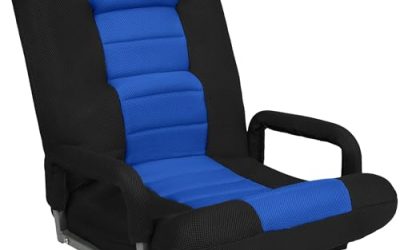
If you’re asking how much is a gaming chair, current U.S. examples range from about $90 for a basic model to around $650 for a more expensive adjustable chair, with options beyond that range. For an initial search, roughly $200–$400 is a useful comparison budget—not a guarantee of quality or comfort. The right amount depends on fit, adjustment needs, construction, and the seller’s terms. This article explains the price differences using documented examples, separates the advertised price from the delivered cost, and shows when spending more addresses a real requirement rather than simply buying a different appearance.
How much is a gaming chair in the United States?
U.S. manufacturer listings checked on October 31, 2026, included gaming chairs priced at $89.99, $179.99, $269.99, $399.99, and $649.99. These examples establish a practical shopping range; they do not represent a market average or the cheapest and most expensive chairs available.
The table below groups those observations into comparison bands. The boundaries are editorial budgeting tools, not standardized industry categories.
| Comparison band | Verified U.S. price example | What the example establishes |
|---|---|---|
| Under $150 | IKEA HUVUDSPELARE, black: $89.99 | A new desk-style gaming chair can cost under $100 |
| $150–$250 | IKEA LÖPARBANA, Vissle dark gray: $179.99 | Options exist below a $200 chair-only budget |
| $250–$350 | Corsair TC100 RELAXED, Fabric Black/Black: $269.99 | A racing-inspired fabric chair sits within this band |
| $350–$500 | IKEA STYRSPEL, dark gray/gray: $399.99 | Another model falls around the $400 mark |
| $500–$700 | Razer Iskur V2 NewGen, Black/Green: $649.99 | More expensive models can approach $650 before checkout costs |
Prices are snapshots for the listed variants, before location-dependent taxes and any applicable charges. They can change, and a displayed price does not confirm immediate delivery to your address. These are price examples, not ranked recommendations.
Use price bands to narrow the search
Start with your maximum total spending limit, then identify chairs whose dimensions and adjustments meet your needs. Comparing every chair in the same price band is less useful when some cannot fit your body or desk.
A $150 limit and a $400 limit lead to different shortlists, but neither amount establishes comfort. A less expensive chair that fits may be more suitable than a larger, more elaborate chair that does not.
Keep the bands flexible during sales. A discounted chair may move into a lower bracket without changing its design, while a special edition may cost more without adding an adjustment you need.
What makes one gaming chair cost more than another?
The price can reflect a combination of mechanisms, upholstery, frame design, size options, accessories, branding, and commercial support. Those factors do not increase together in a predictable way.
To understand a price difference, compare the exact specifications side by side. Identify what changes, then decide whether the change affects your use.
Adjustment mechanisms can add useful capability
Look beyond whether a chair has reclining, tilt, or lumbar support. Check what each control does and the range it provides.
For example, Corsair’s TC100 RELAXED listing specifies 2D armrests, an adjustable lumbar pillow, and a reclining backrest. Razer’s Iskur V2 NewGen listing describes an integrated HyperFlex lumbar support system. These are different approaches to support and adjustment; their presence does not establish which chair will fit you better.
Paying more becomes easier to justify when it buys a capability you have identified as necessary. If your current armrests are too widely spaced, useful inward adjustment matters more than an unrelated decorative upgrade.
Size and fit can change what you need to spend
A chair’s weight limit is a purchasing constraint, while its seat dimensions determine whether it accommodates you. Check both rather than using one as a substitute for the other.
OSHA’s workstation guidance recommends a seat that supports the thighs without pressing behind the knees, supported feet, and armrests that do not interfere with desk positioning. Those criteria are more useful than assuming a chair labeled “XL” will be comfortable.
If suitable proportions are difficult to find, you may need to compare more models or a different chair category. Increasing the budget should expand the search for a fit—not become an automatic instruction to buy the largest model.
Upholstery and special editions can affect the price
Different coverings, colors, and licensed designs can carry different prices within a product family. Verify the selected variant before comparing offers.
Razer’s U.S. catalog, for example, listed the Iskur V2 X in Black/Green fabric at $299.99 and its 2XKO fabric edition at $399.99 when checked. That price difference alone does not demonstrate a proportional improvement in comfort or function.
If appearance matters to you, treat it as a deliberate preference. If you are trying to minimize spending, compare the standard variant before paying for a design you do not particularly want.
How much should you budget for your needs?
A useful budget begins with requirements rather than a price target borrowed from someone else. Record your necessary seat dimensions, weight capacity, desk clearance, and adjustment needs, then see which chairs qualify.
For a broad first comparison, $200–$400 provides a reasonable starting window based on the examples checked. This is an editorial search strategy, not a claim that the range contains the best chairs or suits every buyer.
| Your situation | Budget approach | What to avoid |
|---|---|---|
| Occasional use with straightforward fit requirements | Compare lower-priced models that meet your measurements | Paying for features you will rarely use |
| Gaming and work at the same desk | Prioritize fit, controls, and realistic return options | Assuming longer use requires a particular price |
| Unusual seat-height, width, or depth requirements | Find qualifying dimensions before choosing a spending band | Buying by overall height recommendations alone |
| Strong preference for a particular appearance | Separate the cosmetic premium from functional requirements | Treating a licensed edition as an automatic performance upgrade |
| Uncertainty about comfort | Reserve room for return-related costs | Spending the entire budget on the chair itself |
Spend more to solve an identifiable problem
Before moving to a more expensive option, complete this sentence: “The additional cost gives me…”
A useful answer might be a seat-depth adjustment that the cheaper option lacks, an appropriate size, or a better-documented service arrangement. “It looks more premium” is also a valid preference, but it should not be confused with verified functional improvement.
Do not increase spending solely because of a large discount percentage. Compare the actual price and features against other suitable chairs available at the same time. The crossed-out price does not determine whether the purchase meets your needs.
Keep office chairs in the comparison
A chair does not need gaming branding to work at a gaming desk. If an office chair meets your fit, adjustment, and appearance preferences, include it in the search.
Compare actual products rather than assuming one category is always cheaper, more supportive, or better built. An office chair and a gaming chair may distribute their features differently, so the useful comparison is what you receive for the delivered price.
This also helps prevent unnecessary spending on a category label when your main requirement is simply a suitable desk chair.
Calculate the total cost before checkout
The chair-only price is the starting point. Your checkout total may also include delivery, sales tax, assembly, or optional accessories.
Use this calculation:
Purchase total = chair price + shipping + applicable tax + selected services and accessories − valid discounts
Check the final amount for your delivery address. Do not assume that a free-shipping banner covers every location, product, or service level.
How much is a gaming chair after shipping and tax?
The answer depends on the seller and your location. A product page cannot establish a universal delivered total.
As a hypothetical example, a $300 chair with $25 shipping and $24 in applicable tax totals $349. Those figures illustrate the calculation; they are not a quotation or a tax-rate recommendation.
If $350 is your complete spending limit, a $350 chair-only listing may exceed it at checkout. Work backward from the final budget and leave space for the charges that apply to your order.
Separate required accessories from optional purchases
A footrest, floor protector, replacement casters, or assembly service can increase the total. Add them only when they address a specific need and are compatible with the chair and room.
An accessory is not automatically necessary because it appears in the manufacturer’s suggested bundle. Conversely, omitting something you actually need can make the initial price misleading.
Compare a bundle with the cost of buying only the required items. Also check whether the chair already includes the head or lumbar cushion shown in promotional photographs.
Account for the cost of a chair that does not fit
An inexpensive purchase can become costly to reverse if return freight or deductions apply. Read the assembled-return conditions before ordering, especially when you cannot try the chair locally.
The FTC recommends checking the return deadline, responsibility for shipping, and possible restocking fees. Save the policy applicable to the order alongside your receipt.
You can evaluate the financial uncertainty with a second calculation:
Potential unrecovered return cost = nonrefundable delivery + return shipping + applicable deductions
Do not assign numbers until the seller confirms them. If return shipping is unclear, ask for an estimate using your ZIP code and the packaged item.
Do not treat a warranty as a comfort trial
Warranty coverage and return eligibility serve different purposes. A warranty may address specified defects, while dissatisfaction with seat firmness or size may require a return under separate terms.
Compare coverage details, required documentation, and who handles a claim. A longer advertised warranty is not enough to establish that every component, shipping charge, or problem is covered.
Likewise, avoid assuming that a chair with a longer warranty will last a particular number of years. Warranty duration is a contractual term, not a guaranteed service-life measurement.
Understand sales, used chairs, and replacement costs
Promotions can materially change the price of a specific chair. During research, IKEA’s category page displayed a promotional MATCHSPEL price below its previous price, illustrating why a general price guide needs dated observations.
Compare the exact size, upholstery, seller, and condition. An older search result or another color’s price may not match the offer available to you.
Used and refurbished chairs require a separate evaluation. Check condition, missing parts, remaining support eligibility, and collection or delivery costs. A low asking price does not establish the cost of making a chair usable.
For long-term budgeting, you can calculate a hypothetical cost per year. A $300 chair used for three years would work out to $100 per year before other expenses. That arithmetic is a planning example, not a prediction that the chair will last three years.
Frequently asked questions
Can you buy a gaming chair for under $100?
Yes. IKEA’s U.S. listing showed the black HUVUDSPELARE at $89.99 when checked. Applicable taxes and delivery can increase the total.
That example confirms the price point exists; it does not establish suitability for your body, desk, or intended use.
Is $300 enough for a gaming chair?
It can be enough for the chair itself. The checked Corsair TC100 RELAXED fabric listing was $269.99, and Razer’s Iskur V2 X Black/Green fabric listing was $299.99.
If $300 is your complete budget, verify checkout costs before choosing a model. Neither example is a comfort recommendation.
Does a more expensive chair improve gaming performance?
Price is not evidence of better aim, faster reactions, or higher rankings. Evaluate a chair for fit, usability, and features rather than expecting a competitive-performance benefit.
A setup that suits you may be easier to use comfortably, but no performance improvement is established by the price examples in this article.
Should you wait for a sale?
Consider waiting when your current chair remains usable and you have already identified a suitable replacement. Track the exact variant’s actual price rather than relying only on discount percentages.
Before buying a discounted or clearance chair, check whether its return conditions differ from those of the regular listing.
Conclusion
A gaming chair can cost under $100, while the verified U.S. examples here extend to about $650, with other products outside that range. Use roughly $200–$400 as an initial comparison window if you need a starting point, then let fit and useful adjustments guide the shortlist. Calculate delivery, taxes, required accessories, and potential return costs before deciding what you can afford. Spending more makes sense when it addresses a documented need. The right budget is the amount required for a suitable chair under purchasing terms you understand.