Key takeaways
- Removable parts: A slide-out crumb tray, dishwasher-safe rack, and washable air-fry basket save more time than an extra preset.
- Interior finish: Nonstick interiors wipe easily but can be damaged by abrasive cleaners. Stainless interiors tolerate more scrubbing but show baked-on grease.
- Grease management: Air frying produces more splatter than toast. Clean the tray after fatty foods rather than allowing residue to bake onto the heating area.
- Door clearance: Measure the distance from the back of the oven to the front edge of the open door. Leave enough room to remove a hot rack without reaching over the door.
- Ventilation: Do not push the oven against a wall or place items on top of it. Follow the manual’s clearance requirements, especially under cabinets.
- What wears first: Crumb trays warp, door springs loosen, control markings fade, and nonstick baskets lose their finish before the heating elements usually fail.
The best convection toaster ovens for most kitchens are the Breville Smart Oven Air Fryer Pro for maximum capacity and control, the Cuisinart TOA-70 for a smaller air-frying setup, and a compact 4- to 6-slice convection oven for apartments and light daily use.
Best convection toaster ovens by situation
| Situation | Best fit | Why it works | Main compromise |
|---|---|---|---|
| Small apartment or narrow counter | Compact 4- to 6-slice convection oven | Usually 16–19 inches wide and easier to store | Often cannot fit a 12-inch pizza or full-size casserole |
| Family meals and batch cooking | Large countertop convection oven | Fits a 9-by-13-inch pan, multiple racks, or a 12-inch pizza | Needs substantial heat-safe counter space |
| Frozen food, wings, and fries | Convection oven with a dedicated air-fry basket | Moves more air around food and drains fat below the basket | Fan noise and extra cleanup |
| Toast, reheating, and occasional baking | Simple 4- or 6-slice convection model | Fast preheating, intuitive controls, lower purchase cost | Fewer automatic programs and less temperature precision |
| Replacing a second oven | Large multifunction model such as the Breville Smart Oven Air Fryer Pro | Useful interior height, multiple rack positions, and broad cooking modes | Large footprint, high power draw, and a higher typical price |
Top choices compared
Breville Smart Oven Air Fryer Pro: best for full meals
The Breville Smart Oven Air Fryer Pro is one of the strongest choices when the toaster oven needs to handle more than toast and snacks. Its roughly 1-cubic-foot interior can accommodate a 9-by-13-inch pan, a 12-inch pizza, or several racks of food, depending on the cookware shape. It includes modes such as toast, bagel, bake, roast, broil, pizza, cookies, proof, dehydrate, and air fry.
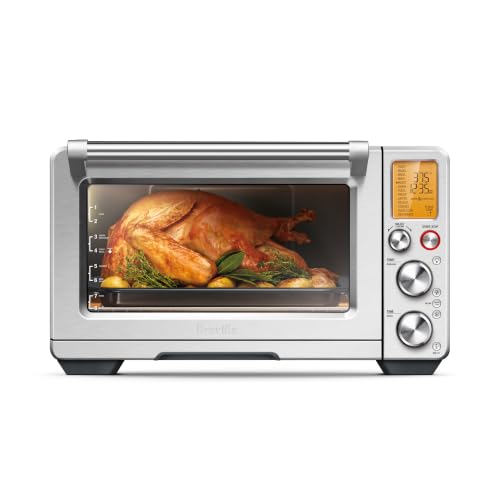
Breville BOV900BSS Smart Oven Air Fryer Pro, Brushed Stainless Steel
Included for 'Best Convection Toaster Ovens for Fast, Even Cooking' because the listing specifies Brushed Stainless Steel, details this guide uses to compare options.
View on Amazon
Ninja Flip Toaster Oven & Air Fryer, 8-in-1, Stainless Steel, SP151
Included for 'Best Convection Toaster Ovens for Fast, Even Cooking' because the listing specifies 8-in-1 and Stainless Steel, details this guide uses to compare options.
View on Amazon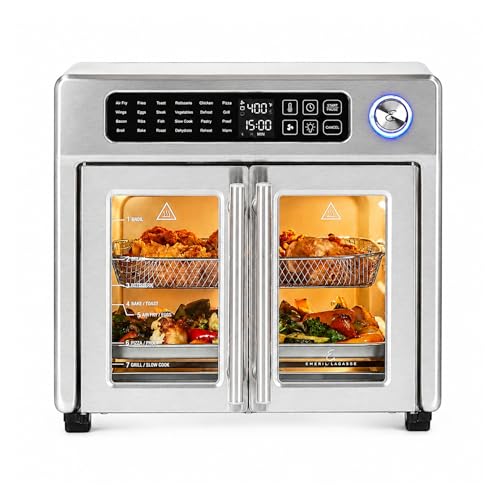
Emeril Lagasse 26QT French Door Multi-Function Air Fryer Toaster Oven
Included for 'Best Convection Toaster Ovens for Fast, Even Cooking' as a relevant option in this category; details come from the product listing.
View on Amazon
BLACK+DECKER TO3250XSBD 8-Slice Extra Wide Convection Countertop Toaster Oven, Includes Bake Pan, Broil Rack & Toasting Rack, Stainless Steel/Black
Included for 'Best Convection Toaster Ovens for Fast, Even Cooking' because the listing specifies Includes Bake Pan and Broil Rack & Toasting Rack, details this guide uses to compare options.
View on AmazonIts large internal cavity is useful for a family meal, but the exterior is also large: approximately 20.5 inches wide, 15.7 inches deep, and 11 inches high, before allowing space for ventilation and the opening door. Plan on at least 3 inches of clearance at the sides and back, and avoid placing it directly beneath low cabinets unless the manufacturer’s instructions permit it. A counter area about 27 inches wide by 20 inches deep is a more realistic working zone than the oven’s published footprint alone.
The digital controls and multi-sensor heating system make it easier to repeat recipes than with a basic dial model. The trade-offs are cost, weight, and cleaning. These large ovens commonly sell in the $300–$500 range, and moving one through a narrow doorway or lifting it onto a counter is a two-person job for many households.
Cuisinart TOA-70: best for air frying without the largest footprint
The Cuisinart TOA-70 combines toaster-oven functions with air frying in a more approachable format. It is suited to toast, reheating, chicken pieces, vegetables, fish, and frozen snacks. Its cooking modes include air fry, bake, broil, toast, convection bake, convection broil, grill, and warming.
This type of oven is a practical middle ground: more versatile than a basic 4-slice toaster oven, but less demanding than an extra-large model. Expect a footprint in the neighborhood of 16 inches wide by 15–17 inches deep, depending on the exact version and handle clearance. Verify the current dimensions before purchase, because a protruding control panel or rear vent can make a tight countertop installation difficult.
The air-fry basket improves crispness by exposing food to circulating heat, although it also allows grease and crumbs to fall onto the pan below. Line the pan when the manufacturer allows it, but do not block vents or place loose parchment inside during preheating. Models in this category usually cost about $200–$300.
Compact convection toaster oven: best for renters and small kitchens
A compact 4- to 6-slice convection toaster oven is often the better decision when counter space matters more than capacity. Look for an interior that can fit at least a 9-inch pizza or a 9-by-9-inch baking dish. A model measuring approximately 17 inches wide, 13 inches deep, and 10 inches high can work well in a small apartment, provided the door can open without striking a backsplash or cabinet.
These ovens are generally quickest for one or two portions: toast, an open sandwich, reheated pizza, a baked potato, or a small tray of vegetables. They usually cost $80–$180. Their limitations become obvious when cooking for several people: a small tray may need two batches, and the close spacing between the food and upper element can brown the top before the center is done.
Capacity is more than the advertised slice count
“Six-slice” and “12-slice” labels are rough categories, not reliable measures of usable space. Measure the interior width, depth, and height, then compare those numbers with the pans you already own.
| Cooking task | Useful minimum interior | Recommended oven category |
|---|---|---|
| Two slices of toast or one snack | 9–10 inches wide | Compact |
| 9-inch pizza or small casserole | At least 11 inches wide and 10 inches deep | Compact to medium |
| 12-inch pizza | At least 13 inches of usable width | Medium or large |
| 9-by-13-inch pan | About 14 inches wide and 11 inches deep, with adequate height | Large |
| Two racks of food | Multiple rack positions and at least 12 inches of interior height | Large multifunction oven |
Account for the handles on baking dishes, the rim of an air-fry basket, and the space needed for hot air to circulate. A pan that technically fits may still cook poorly if it nearly touches the walls.
Temperature accuracy and cooking performance
Convection reduces cooking time by moving hot air around the food, but it does not automatically guarantee even browning. The best models use electronic controls, multiple heating elements, and sensors that adjust power during the cycle. Basic dial-controlled ovens can work well, but their actual temperature may differ from the setting, especially during long bakes.
For repeatable baking, use an inexpensive oven thermometer during the first few uses. If the oven runs 25°F hotter than its display, reduce the setting or shorten the cooking time. Rotate a tray halfway through cooking when the manual recommends it, particularly for cookies and foods placed near the edges.
Air-fry modes generally require a lower temperature and shorter time than conventional oven directions. Start by reducing the temperature by about 25°F, check food early, and avoid crowding the basket. A full basket blocks airflow and produces softer results.
Cleanup, safety, and durability details
- Removable parts: A slide-out crumb tray, dishwasher-safe rack, and washable air-fry basket save more time than an extra preset.
- Interior finish: Nonstick interiors wipe easily but can be damaged by abrasive cleaners. Stainless interiors tolerate more scrubbing but show baked-on grease.
- Grease management: Air frying produces more splatter than toast. Clean the tray after fatty foods rather than allowing residue to bake onto the heating area.
- Door clearance: Measure the distance from the back of the oven to the front edge of the open door. Leave enough room to remove a hot rack without reaching over the door.
- Ventilation: Do not push the oven against a wall or place items on top of it. Follow the manual’s clearance requirements, especially under cabinets.
- What wears first: Crumb trays warp, door springs loosen, control markings fade, and nonstick baskets lose their finish before the heating elements usually fail.
For a heavy model, check the counter’s depth and strength before installation. A large oven can weigh roughly 20–35 pounds, and the load becomes harder to control when the counter is wet or the appliance is pulled forward. Keep the path to the counter clear: narrow cabinet openings, raised thresholds, and a doorway under 30 inches wide can make moving a bulky oven awkward.
How to choose the right one
Start with the largest meal you expect to cook. If that is frozen snacks or two servings of toast, choose compact capacity and easy controls. If it is a casserole, a 12-inch pizza, or a family dinner, prioritize interior dimensions and rack positions over the number of presets. Then measure the counter, add ventilation clearance, and confirm that the door can open fully.
For most buyers, a medium convection toaster oven with an air-fry basket offers the best balance of price, footprint, and versatility. Choose a large model only when its extra capacity will replace frequent use of a full-size oven. Choose a compact model when saving counter space is the main goal; a smaller oven that fits safely and gets used daily is more valuable than a feature-rich appliance that overwhelms the kitchen.