Key takeaways
- Body length: A 40–48-inch deck suits many adults; taller mechanics may need a 48–52-inch model or a design with a shaped headrest.
- Width: About 16–18 inches improves access between tires and frame rails, while 20–22 inches provides more shoulder room.
- Floor clearance: Compare the creeper’s loaded height with the lowest point beneath the vehicle, not an unloaded catalog measurement alone.
- Doorways: Measure garage and storage door widths if the assembled creeper must pass through them. A typical 45-inch length is not a problem for most doors, but a wide rigid deck can be awkward to turn.
- Storage footprint: A fixed model may need roughly 4 feet of wall or floor space. A folding model can reduce that to a narrow vertical area, but must be secured so it cannot fall.
The best creepers for mechanics are low-profile rolling models with a padded, oil-resistant surface, large enough wheels for your garage floor, and a weight rating that leaves a useful safety margin above your body weight and tools.
Quick picks by garage situation
| Situation | Best creeper type | Specifications to target | Why it fits |
|---|---|---|---|
| Smooth concrete and frequent repairs | Low-profile mechanic’s creeper | 2.5–3 in wheels, 40–48 in length, 350–450 lb capacity | Rolls efficiently and keeps your body close to the vehicle |
| Cracked or uneven garage floor | Heavy-duty padded creeper | 3–4 in wheels, steel frame, 400 lb or higher capacity | Larger wheels are less likely to stop in joints and debris |
| Limited storage space | Folding or convertible creeper | Folded thickness under 8 in; locking hinges; 300 lb or higher capacity | Can stand against a wall or become a low mechanic’s seat |
| Back, neck, or shoulder discomfort | Contoured padded creeper | 2–4 in foam padding, raised headrest, 18–22 in shoulder width | Supports the torso and reduces pressure from bare metal frames |
| Oil, coolant, and brake-cleaner exposure | Vinyl-covered padded model | Welded or sealed upholstery; replaceable cushion preferred | Wipes clean more easily than fabric or exposed foam |
What separates the best creepers for mechanics
Padded material and body support
Padding is more than a comfort feature when a repair takes several hours. A thin vinyl cover over hard foam may feel acceptable for a short inspection but can create pressure points at the shoulder blades and tailbone. Look for a contoured deck with approximately 2–4 inches of foam, a supported headrest, and enough width for your shoulders without forcing your elbows outward.
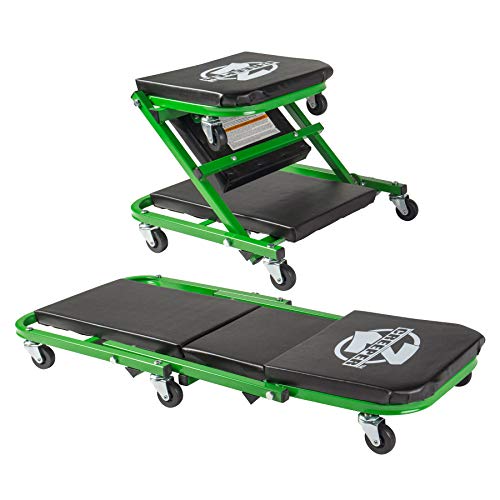
Pro-LifT Mechanic Creeper
Included for 'Best Creepers for Mechanics' as a relevant option in this category; details come from the product listing.
View on Amazon
M-AUTO Foldable Z Creeper 2-in-1 Rolling Folding Car Creeper & Seat, 36" Adjustable Roller Garage Chair Lay Down or Sit, 330LBS Capacity Under Car Roller Creeper with 6 Swivel Casters, Red
Included for 'Best Creepers for Mechanics' because the listing specifies 36" Adjustable Roller Garage Chair Lay Down or Sit and Red, details this guide uses to compare options.
View on Amazon
BIG RED TRP6240 Torin Blow Molded Plastic Rolling Garage/Shop Creeper: 40" Mechanic Cart with Padded Headrest, Dual Tool Trays and 6 Casters, Red
Included for 'Best Creepers for Mechanics' because the listing specifies Dual Tool Trays and 6 Casters and Red, details this guide uses to compare options.
View on Amazon
VEVOR Mechanic Garage Creeper, 40-Inch, 300 lbs Capacity Automotive Rolling Creeper with 6 Casters Adjustable Cushioned Headrest, Heavy Duty Steel Frame Low Profile for Garages, Repair Shops, and DIY
Included for 'Best Creepers for Mechanics' because the listing specifies 40-Inch and Heavy Duty Steel Frame Low Profile for Garages, details this guide uses to compare options.
View on AmazonVinyl is usually the most practical covering for a garage because it resists oil and can be wiped down. It can become cold and stiff in an unheated garage, and cheap vinyl may split at the folds. Molded plastic beds are easy to clean and will not absorb fluids, but they transmit more vibration and provide less cushioning. Fabric covers feel warmer but absorb spills and can retain grit, so they are best reserved for clean workshop environments.
| Surface or construction | Advantages | Trade-offs | Best use |
|---|---|---|---|
| Vinyl over foam | Comfortable, wipe-clean, commonly repairable | Can crack in cold weather; seams may split | General automotive work |
| Molded plastic | Resists fluids, dirt, and corrosion | Less cushioning; can become slippery | Wet or frequently contaminated garages |
| Fabric over foam | Warm and comfortable | Absorbs oil and is harder to clean | Clean, enclosed workshops |
| Exposed steel or hard composite | Durable and inexpensive | Uncomfortable for long jobs; transfers floor vibration | Occasional inspections and emergency use |
Wheel size matters more than wheel count
Most automotive creepers use six or more casters, but a larger wheel often makes a bigger difference than adding another small caster. Wheels around 2.5 inches roll well on smooth sealed concrete. For garage floors with expansion joints, small stones, or worn patches, 3-inch wheels are a safer minimum. Wheels around 4 inches can cross rougher surfaces, although they may raise the deck slightly and increase the chance of striking low vehicle components.
Hard nylon or polypropylene wheels roll efficiently and do not absorb oil, but they transmit more noise and vibration. Soft polyurethane wheels are quieter and kinder to painted floors, yet they can collect debris and develop flat spots if the creeper is stored under load. Swivel casters at every end improve steering, while fixed wheels can make a long creeper track more predictably under a vehicle.
Height, head clearance, and vehicle access
A low creeper is useful only if it fits beneath the vehicle. Measure the lowest obstruction—not just the rocker panel—after the vehicle is safely supported. Many low-profile creepers place the user’s torso roughly 4–6 inches above the floor, while padded or high-clearance designs may sit 6–9 inches high. That difference can determine whether your chest clears an exhaust component or whether your head contacts a crossmember.
Allow at least 2 inches of head and shoulder clearance around the creeper when positioning yourself. If the underside has a narrow tunnel, a slimmer model around 16–18 inches wide may work better than a 20–22-inch comfort-oriented design. For large trucks and SUVs, a wider padded deck is usually preferable, but check the distance between the tires and the lowest frame or suspension parts before buying.
Remember that a creeper cannot compensate for insufficient lifting height. Never enter beneath a vehicle supported only by a jack. Use properly rated jack stands on a stable, level surface, and confirm that the raised vehicle remains secure before rolling underneath.
Weight capacity is not a target weight
Capacity ratings commonly range from approximately 250 to 450 pounds, with heavy-duty models rated higher. Choose a creeper whose published capacity exceeds your body weight plus clothing, a cordless light, hand tools, and any parts you may carry. For example, a 220-pound mechanic carrying 25 pounds of tools should avoid a 250-pound model; a 350-pound rating gives a more sensible margin.
Capacity also depends on how the load is distributed. Sitting heavily on a headrest, dropping onto the deck, or concentrating weight on one edge can stress hinges and caster mounts more than lying flat. Convertible models deserve particular attention because folding joints introduce additional wear points.
Folding versus fixed and convertible designs
A fixed creeper is generally the simplest choice for regular work. Its rigid frame has fewer moving parts, rolls quietly, and usually provides the most predictable support. The drawback is storage: a 45-inch creeper needs a wall section or floor space that remains clear.
Folding creepers solve the storage problem, but inspect the hinge design before focusing on padding. The locking mechanism should engage positively in both the flat and folded positions, without relying on a loose pin that can be lost. A folded length or thickness below approximately 8 inches is easier to store beside a tool cabinet, although compact designs may shorten the usable body area.
Convertible creepers can change from a flat platform into a low seat. This is useful for brake, wheel, and side-panel work, where repeatedly standing and lying down is tiring. However, the hinge can create a pressure ridge, and the seat position may be too low for some users. Treat the seat rating and flat-creeper rating as separate specifications if the manufacturer lists them separately.
Size and storage checks before ordering
- Body length: A 40–48-inch deck suits many adults; taller mechanics may need a 48–52-inch model or a design with a shaped headrest.
- Width: About 16–18 inches improves access between tires and frame rails, while 20–22 inches provides more shoulder room.
- Floor clearance: Compare the creeper’s loaded height with the lowest point beneath the vehicle, not an unloaded catalog measurement alone.
- Doorways: Measure garage and storage door widths if the assembled creeper must pass through them. A typical 45-inch length is not a problem for most doors, but a wide rigid deck can be awkward to turn.
- Storage footprint: A fixed model may need roughly 4 feet of wall or floor space. A folding model can reduce that to a narrow vertical area, but must be secured so it cannot fall.
Which design should you choose?
Choose a low-profile fixed creeper if you work under cars weekly and have smooth concrete with permanent storage space. Choose a heavy-duty model with 3-inch or larger wheels if your floor has cracks, gravel, or expansion joints. Choose a folding model for a one-car garage where every wall section is already occupied. Choose a convertible seat-and-creeper when your repairs alternate between underbody work and jobs at wheel height.
For back comfort, prioritize contoured foam, a supported headrest, and wheel movement over the thinnest possible deck. For cleaning, choose sealed vinyl or molded plastic rather than fabric. For tall users, confirm usable body length and headrest position; a high weight capacity does not make a short creeper comfortable.
Durability details that listings often omit
Casters, hinge pins, wheel bearings, and upholstery seams usually wear before the main frame. Inspect whether replacement casters are available and whether each caster is attached with substantial bolts or reinforced plates. A welded steel frame can tolerate years of use, but exposed steel should be painted or powder-coated because brake cleaner, salt, and damp floors encourage corrosion.
Before first use, tighten caster hardware, verify that every wheel swivels freely, and check that folding locks engage fully. Keep the wheels free of wire, hair, and shop rags. Clean oil from the deck promptly, since a slick surface can make it difficult to brace yourself while reaching for tools. With those checks in place, the best creepers for mechanics are the ones that match your floor and vehicle clearance—not necessarily the model with the most padding or the highest advertised capacity.