Key takeaways
- Espresso grinder: Prioritize consistent fine adjustment over a large bean hopper.
- Digital scale: A model accurate to 0.1 gram helps you repeat the dose and beverage yield.
- Small dosing cup: Reduces spilled grounds when transferring coffee to the portafilter.
- 58 mm or machine-specific tamper: Match the diameter to the supplied basket; a loose tamper is difficult to use consistently.
- Microfiber cloth and group brush: These make daily cleanup quick.
- Milk pitcher: A 12-ounce pitcher is manageable for one drink; a 20-ounce pitcher suits two drinks.
- Filtered water: It can reduce mineral buildup and improve taste, provided it is appropriate for espresso equipment.
The best espresso machine for beginners is usually a compact semi-automatic with a fast heat-up, simple buttons, forgiving grind adjustment, and an accessible cleaning routine; for most people, that means the Breville Bambino Plus, while budget buyers should consider the De’Longhi Dedica and hands-on learners the Gaggia Classic Pro.
Quick picks by situation
| Situation | Best fit | Why it makes sense | Typical machine price |
|---|---|---|---|
| You want the easiest first machine | Breville Bambino Plus | Very fast heat-up, automatic milk texturing, and forgiving beginner controls | Usually $400–$550 |
| You have very little counter space | De’Longhi Dedica | Narrow body and straightforward pressurized-basket brewing | Usually $150–$250 |
| You want to learn traditional espresso | Gaggia Classic Pro | Standard-style workflow, replaceable parts, and a strong accessory ecosystem | Usually $400–$600 |
| You prefer durability and repairability | Rancilio Silvia | Sturdy construction and a commercial-style portafilter, although the workflow is less forgiving | Usually $800–$1,000 |
| You want one-touch convenience | Automatic bean-to-cup machine | Grinds and brews with minimal technique, but produces less control and often more cleaning | Usually $500–$1,500 |
What beginners should prioritize
Simple controls beat a long feature list
A beginner-friendly machine should let you select a single or double shot without navigating menus. Physical buttons or a clearly labeled control panel are easier to understand than a large display filled with programmable options.

CASABREWS 3700 Essential Stainless Steel Espresso Machine with Steam Wand
Included for 'Best Espresso Machines for Beginners' as a relevant option in this category; details come from the product listing.
View on Amazon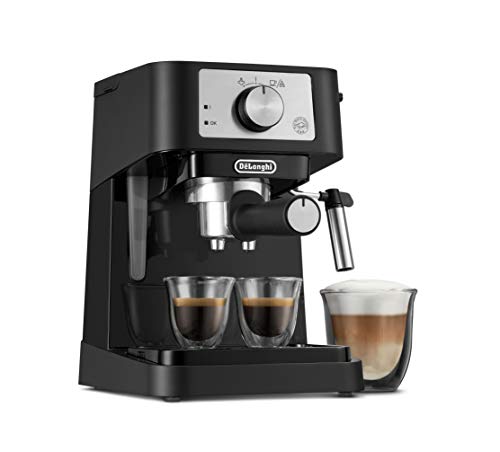
De'Longhi Stilosa Compact Manual Espresso Machine, Manual Milk Frother
Included for 'Best Espresso Machines for Beginners' because the listing specifies Manual Milk Frother, details this guide uses to compare options.
View on Amazon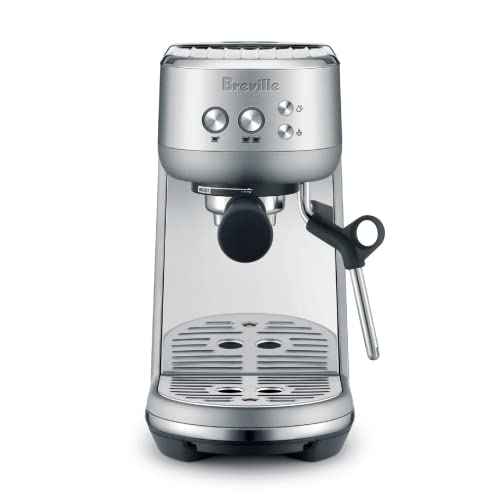
Breville BES450BSS Bambino Espresso Machine, Brushed Stainless Steel
Included for 'Best Espresso Machines for Beginners' because the listing specifies Brushed Stainless Steel, details this guide uses to compare options.
View on Amazon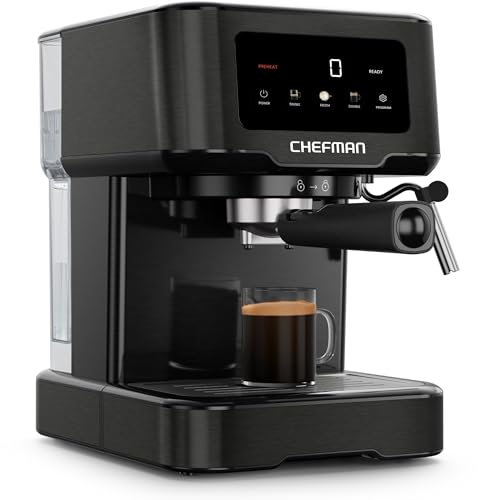
Chefman CraftBrew Espresso Machine, 15-Bar Pump Digital Espresso Maker w/Steam Wand for Latte & Cappuccino, Compact Espresso Coffee Machine w/ 1.5L Removable Water Reservoir - Stainless Black
Included for 'Best Espresso Machines for Beginners' because the listing specifies Stainless Black, details this guide uses to compare options.
View on AmazonVolumetric dosing can be useful, but it should not be treated as automatic perfection. Espresso changes with the coffee, grind size, dose, and freshness, so you will still need to stop a shot manually from time to time. A machine with a simple manual mode gives you room to improve without forcing you to learn every setting on day one.
Heat-up time matters during rushed mornings
Machines with thermoblock or thermocoil heating systems can be ready in roughly 3–10 seconds for brewing. The Bambino Plus is known for an especially short startup period. Traditional single-boiler machines, including the Gaggia Classic Pro and Rancilio Silvia, commonly need several minutes to warm up fully, and the portafilter should warm along with the machine.
Fast startup does not always mean faster overall service. If you are making several milk drinks, a compact thermoblock machine can be convenient, while a single-boiler machine may require a wait between brewing and steaming. For one or two drinks before work, the faster system is usually easier.
Pressure consistency is more important than a high pressure number
Many machines advertise a 15-bar pump, but espresso is generally brewed around 9 bars at the coffee puck. The useful question is whether the machine delivers reasonably stable pressure while water flows through the grounds—not whether the box lists the highest bar rating.
Pressurized baskets make pressure less dependent on perfect grinding. They are helpful when using pre-ground coffee or an inexpensive grinder, but they can hide problems and produce less control. Once you own a capable espresso grinder, non-pressurized baskets provide more clarity and adjustment.
The grinder may matter more than the machine
A modest espresso machine paired with a suitable grinder will usually outperform an expensive machine paired with an inconsistent grinder. Espresso requires a fine, repeatable grind, and small changes can alter a shot from fast and thin to slow and bitter.
For beginners, a grinder with stepless or very small adjustment increments is easier to dial in than one with large jumps. The Baratza Encore ESP is designed for espresso adjustment, while the Fellow Opus offers a compact all-purpose option. The Turin DF54 is another type of dedicated single-dose grinder to consider when you want finer control and low retained coffee.
Expect to spend about $150–$450 on a capable entry-level espresso grinder. Blade grinders and basic drip-coffee grinders are poor matches because they produce too many boulders and fines. If your machine includes a pressurized basket, you can start with pre-ground coffee, but a good grinder becomes the more important upgrade later.
Head-to-head: the most useful beginner choices
Breville Bambino Plus versus De’Longhi Dedica
The Bambino Plus is the better choice if you want fast brewing and easier milk drinks. Its automatic steam-wand temperature control reduces the risk of overheating milk, and the machine reaches brewing temperature very quickly. It is wider and more expensive than the Dedica, and its small footprint still requires room above the drip tray for a cup and portafilter.
The Dedica is a better fit for a narrow kitchen or a low-cost first purchase. Its body is approximately 6 inches wide, depending on the exact model, so it can fit where many standard machines cannot. Its pressurized baskets are forgiving, but its included tamper and accessories are basic, and milk steaming requires more practice.
Gaggia Classic Pro versus Rancilio Silvia
Both machines suit someone who wants a more traditional workflow. The Gaggia is generally less expensive and easier to place in a beginner setup. The Silvia has a heavier build and a stronger steam system, but it costs more and benefits from careful temperature management because it uses a single boiler.
Neither is ideal if you need coffee immediately after waking up. Allow around 5–15 minutes for proper warm-up, depending on ambient temperature and preparation habits. They reward learning, but they are less forgiving than a fast thermoblock machine with automatic milk control.
Size, clearance, and kitchen fit
Measure more than the machine’s footprint. Leave at least 3 inches of open space at the sides for handling the portafilter and wiping down the body. Leave 6–8 inches above the machine if you need to remove a water tank from the top. A front-loading tank is more convenient beneath cabinets.
| Machine type | Typical width | Typical depth | Useful clearance | Best room fit |
|---|---|---|---|---|
| Narrow thermoblock machine | 6–8 inches | 12–14 inches | 3 inches per side; 6 inches above | Small apartment or shared kitchen |
| Compact semi-automatic | 8–10 inches | 13–16 inches | 4 inches per side; 8 inches above | Most standard counters |
| Traditional single-boiler machine | 9–10 inches | 15–17 inches | 4 inches per side; 8–12 inches above | Dedicated coffee corner |
| Bean-to-cup automatic machine | 9–16 inches | 16–20 inches | 6 inches above for hopper access | Larger kitchen with daily convenience priority |
In a 10-by-12-foot room, the machine itself is rarely the issue; the grinder, knock box, cups, and cleaning supplies often consume more usable space. A coffee station about 24–30 inches wide gives a compact machine enough working room without taking over a small counter.
Cleaning demands you should expect
Every espresso machine needs more than an occasional rinse. After each drink, wipe and purge the steam wand immediately so milk does not bake onto the tip. Knock out the puck, rinse the portafilter, and flush the group head briefly.
Once a week, wash the drip tray and water tank and brush coffee residue from the group screen. Backflush with the manufacturer’s recommended cleaning product when the manual calls for it. Descale according to your water hardness and the machine’s instructions; frequent descaling is not a substitute for using filtered water.
Automatic milk systems can save steaming effort but may require cleaning tubes, carafes, and internal channels after every use. If you only drink black espresso, a manual steam wand is often simpler over the long term.
Accessories that are actually useful
- Espresso grinder: Prioritize consistent fine adjustment over a large bean hopper.
- Digital scale: A model accurate to 0.1 gram helps you repeat the dose and beverage yield.
- Small dosing cup: Reduces spilled grounds when transferring coffee to the portafilter.
- 58 mm or machine-specific tamper: Match the diameter to the supplied basket; a loose tamper is difficult to use consistently.
- Microfiber cloth and group brush: These make daily cleanup quick.
- Milk pitcher: A 12-ounce pitcher is manageable for one drink; a 20-ounce pitcher suits two drinks.
- Filtered water: It can reduce mineral buildup and improve taste, provided it is appropriate for espresso equipment.
Which one should you buy?
Choose the Breville Bambino Plus if fast startup and easy milk drinks are your priorities. Choose the De’Longhi Dedica if counter width and price matter most. Choose the Gaggia Classic Pro if you want to learn espresso technique and upgrade accessories over time. Choose the Rancilio Silvia if you value a heavier, more repairable traditional machine and do not mind a slower workflow.
Whichever machine you select, reserve part of the budget for a real espresso grinder, a scale, and basic cleaning tools. Those three additions usually improve the first month of espresso more than paying extra for decorative features or a higher advertised pump-pressure number.