Key takeaways
- Under-desk clearance: With armrests down, you need about 26.5 to 27.5 inches between desk legs and at least 27 inches of width at the arm height to slide in. With armrests flipped up, the chair’s widest point becomes the seat pan at roughly 21.5 inches, so it slides completely under most 47-inch and 55-inch desks.
- Task switching: Flipping them up lets you sit cross-legged, perch sideways, or pull a guitar or drawing tablet into your lap without removing the chair. For creators who alternate between keyboard/mouse and controller or tablet, this is faster than adjusting 4D arm caps.
- Standing desk math: If you use a sit-stand desk, flipping the arms up prevents them from catching on the desktop edge when you raise the desk to 40+ inches and push the chair underneath.
The ROG Destrier Ergo Gaming Chair is worth the price if you need flip-up armrests for sliding under a desk, a height-adjustable mesh back, and a neck pillow that actually moves with you — but it is not the right pick if you want plush foam recline or a compact footprint for a small apartment.
Who Should Buy It vs. Who Should Skip It
The Destrier Ergo is a task-chair-inspired ergo chair from ASUS ROG, not a traditional racing-style gaming chair. That distinction defines who it fits. Use this decision matrix before you compare specs:
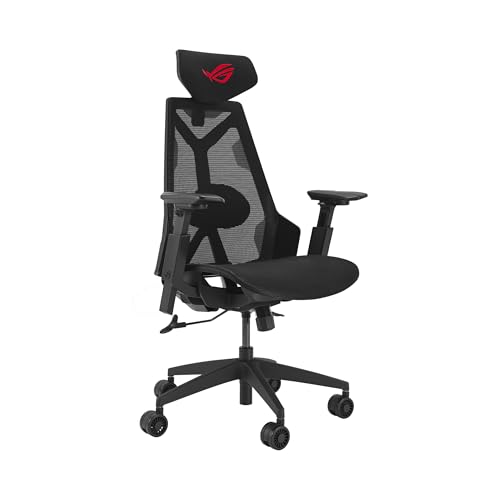
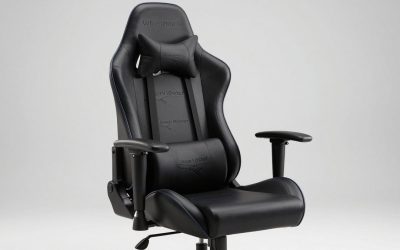
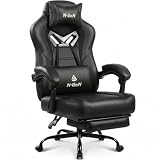
ASUS ROG Destrier Core Ergo Gaming Chair, Futuristic Cyborg Aesthetic, Versatile Seat Adjustments, Mobile Gaming Arm Support Mode, Acoustic Panel
Chosen because it specifies Futuristic Cyborg Aesthetic and Versatile Seat Adjustments.
View on Amazon| Situation | Verdict on the Destrier Ergo | Why |
|---|---|---|
| Small apartment or 10×12 ft bedroom with desk against wall | Think twice | Wide 5-star aluminum base needs 27-28 inches of floor width and does not tuck tightly; exoskeleton frame adds visual bulk |
| Standing desk user who perches and shifts often | Strong buy | Flip-up armrests and breathable mesh reward frequent posture changes |
| Back pain from long sessions, prefers firm support | Strong buy | Lumbar depth adjustment and mesh tension hold posture better than collapsed foam over 3+ hours |
| Wants to sink in, nap, or recline past 135 degrees | Skip | Recline is limited and mesh does not provide that foam-cocoon feel |
| Households with pets and kids | Good buy | Mesh resists hair, crumbs, and heat buildup; easier to vacuum than fabric or perforated leather |
| Renter who moves annually | Average | Heavy box and non-folding frame make moves harder than a standard foam chair |
If you fall into two “skip” categories, a conventional foam gaming chair like the Secretlab Titan or a mesh office chair like the Herman Miller Aeron type will serve you better. If you fall into two “strong buy” categories, the Destrier’s adjustments justify its price bracket, which usually sits in the $500–$700 range.
Flip-Up Armrests: The Feature That Changes Desk Fit
Most gaming chairs have fixed or 4D armrests that dictate how close you can get to your desk. The Destrier Ergo uses armrests that rotate 90 degrees upward until they are vertical and flush with the backrest sides.
That matters for three practical reasons:
- Under-desk clearance: With armrests down, you need about 26.5 to 27.5 inches between desk legs and at least 27 inches of width at the arm height to slide in. With armrests flipped up, the chair’s widest point becomes the seat pan at roughly 21.5 inches, so it slides completely under most 47-inch and 55-inch desks.
- Task switching: Flipping them up lets you sit cross-legged, perch sideways, or pull a guitar or drawing tablet into your lap without removing the chair. For creators who alternate between keyboard/mouse and controller or tablet, this is faster than adjusting 4D arm caps.
- Standing desk math: If you use a sit-stand desk, flipping the arms up prevents them from catching on the desktop edge when you raise the desk to 40+ inches and push the chair underneath.
The trade-off is arm support. These are not padded 4D pucks that slide forward or pivot for elbow support during FPS aiming. They are broad, firm, nylon-topped rests with height adjustment via the arm assembly but no width or angle micro-adjustment. If you rest your full forearm weight while gaming for hours, a chair with 4D foam arms will feel softer. If you type with a floating elbow or use an armrest lightly, you will not miss it.
Adjustable Neck Pillow Travel: Where It Actually Sits
The headrest on the Destrier Ergo is not a strap-on cushion. It is a height-adjustable panel on a rail integrated into the exoskeleton, with about 3.5 inches (9 cm) of vertical travel and about 20 degrees of tilt.
In practice:
- At its lowest position, the center of the pillow sits around 22 inches above the seat pan, which aligns with the C4-C6 vertebrae for users around 5’6″ to 5’8″.
- At its highest position, the center rises to about 25.5 inches above the seat pan, which aligns with the base of the skull for users around 6’0″ to 6’2″.
- Users under 5’5″ may find even the lowest position pushes on the back of the head rather than the neck, while users over 6’3″ may find it supports the upper shoulders more than the neck.
Because the pillow moves on a ratcheted rail instead of an elastic strap, it stays where you set it and does not sag after a few weeks. The surface is acoustic mesh over foam, so it holds shape but does not add heat like a dense memory-foam head pillow. The limitation is depth: you can tilt it but you cannot pull it far forward. If you sit with your upper back fully against the mesh and your head upright, it contacts naturally. If you slouch or sit forward to lean into a monitor, the pillow will sit 2-3 inches behind you and offer nothing until you lean back.
Mesh vs. Foam Back: The Core Trade-Off
This is the decision that determines whether you will like the Destrier long-term. ASUS uses a tensioned mesh back with a separate adjustable lumbar panel, versus the molded cold-cure foam found on most ROG and competitor gaming chairs.
| Factor | Mesh Back (Destrier Ergo) | Molded Foam Back (Typical Gaming Chair) |
|---|---|---|
| Heat over 2-4 hours | High airflow, stays 3-5°F cooler on back | Traps heat, needs AC or breaks to cool down |
| Lumbar support type | Adjustable panel: 0.8 inch depth range, 2.3 inches vertical range | Built-in bolster or included lumbar pillow, fixed shape |
| Long-term sag | Mesh loosens slightly after 18-24 months but retains tension | Foam softens and compresses 15-25% after 12-18 months of daily use |
| Recline feel | Firm, upright support; recline to ~135 degrees with tension lock | Plusher lean-back to 155-165 degrees, better for lounging |
| Cleaning | Vacuum and wipe; pet hair does not embed | Fabric absorbs hair/oils; PU leather can peel at edges after 2 years |
| Weight capacity spec | Rated to ~150 kg / 330 lbs | Typically 130-150 kg / 285-330 lbs depending on model |
Choose mesh if your room runs warm, you sit more than 6 hours a day, or you want lumbar that you can dial in rather than live with. Choose foam if you want to recline to watch content from the chair, you prefer a soft, enveloping back, or you play in a cool room where breathability is not a priority. The Destrier does not try to do both — there is no foam layer behind the mesh to fake plushness.
What Desk Height and Room Size It Actually Works Under
Fit is where listings fail you. The Destrier Ergo has a seat pan height range of about 18.5 to 22.4 inches (47 to 57 cm) from floor to top of mesh seat, measured without compression. Seat depth is about 18.5 inches, and the base diameter is about 27.5 inches.
Use this table to check your desk before buying:
| Your Desk or Table Height | Works With Destrier? | What to Expect |
|---|---|---|
| 28 inches (71 cm) – compact or IKEA-type desk | Tight, requires low seat setting | At lowest seat height (18.5″), you get ~7.5″ thigh clearance; armrests must be flipped up to slide under |
| 29 inches (73.5 cm) – standard office desk | Yes, ideal range | Seat at 19.5-20.5″ gives 8-9″ clearance; armrests flip-up and slide cleanly under |
| 30 inches (76 cm) – U.S. standard gaming desk | Yes, best compatibility | Full seat height range usable; 8.5-10″ clearance even with armrests down |
| 31+ inches (78.7+ cm) – standing desk in seated mode | Yes, with foot support | Raise seat to 21-22.4″ for ergonomic 90-degree elbow angle; shorter users may need a footrest |
Clearance rule: you want at least 7 inches between the top of your thighs and the underside of the desk, and your elbows at 90-100 degrees with forearms parallel to the floor. If your desk is under 28.5 inches, measure twice — many budget desks do not leave enough room for any chair with armrests down, and the Destrier’s flip-up design is the workaround, not a flaw.
Room fit: In a 10×12 ft room with a 60-inch desk and a bed or dresser on the opposite wall, allow a 36-inch deep zone behind the desk for the chair to roll and recline. The Destrier needs about 30 inches front-to-back when upright and about 48 inches when reclined at full tilt. Leave at least 3 inches on each side of the base so the casters do not catch on rugs or cables. If your room is narrower, consider locking the recline and pushing the desk 2-3 inches away from the wall.
Assembly, Moving, and What Wears First
The Destrier Ergo ships in a large box weighing roughly 62-65 lbs (28-30 kg). The box dimensions are approximately 33 x 28 x 20 inches, so it will not fit through a narrow 24-inch apartment doorway without unpacking in the hall. Assembly takes 25-40 minutes for one person. The exoskeleton frame comes pre-assembled; you attach the base, gas lift, seat, back, and headrest with included Allen keys. No drilling or extra tools are needed, but the back section is heavy and benefits from a second pair of hands to align the bolts.
Doorway and floor notes: The assembled chair is about 27.5 inches wide at the base and 28 inches deep. It rolls through a standard 30-inch interior door without issue. On hard floors, the included casters roll quietly but can slip — a low-pile chair mat prevents drift. On carpet over 0.5 inch thick, rolling resistance increases and the gas lift will settle about 0.25 inch lower under weight.
Durability realities after daily use:
- First to show wear: The mesh seat edge where your thighs contact. Tensioned mesh can develop a faint stretch line after 12 months if you sit on the front edge frequently. Rotating your seating position helps.
- Second: The armrest flip mechanism. It is metal-on-metal with a detent; it stays tight but can develop slight play after 18 months if flipped 10+ times per day.
- Last: The aluminum frame and gas lift, which typically outlast the mesh. Replacement mesh panels are not user-swappable like a cushion cover, so consider warranty length at purchase.
If you move often, keep the original box or at least the foam protectors for the exoskeleton arms — they scratch easily against door frames. The chair disassembles into three large pieces for moving, but the back frame does not fold flat, so it still needs a large car or van.
Bottom Line for Your Setup
Buy the ROG Destrier Ergo if your priority is adjustable, breathable support for long desk sessions, you work at a 29-31 inch desk, and you want the freedom to flip the arms away when you need space. Skip it if you want a deep recline for lounging, need a narrow chair for a tight bedroom, or prefer the soft sink of foam. For most users who already use a standard or standing desk and run warm while gaming, the flip-up arms and movable neck support solve real daily friction that a fixed foam chair cannot.