Key takeaways
- Peak cooling headroom: A 360mm AIO pulls ahead under sustained all-core loads and aggressive overclocks; a quality twin-tower air cooler matches or beats a 240mm AIO in typical gaming workloads.
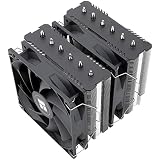
- Noise profile: AIOs have a pump plus three fans and can develop gurgle or whine over time; air coolers have one or two slow-spinning fans and no moving liquid, so the Peerless Assassin 120 SE stays inaudible in a closed case at 1550RPM.
- Reliability and lifespan: An air cooler’s only failure point is a fan bearing you can replace for pocket change. AIOs have pumps, seals, and coolant that degrade, with realistic service lives of roughly five to seven years.
- Physical clearance: AIOs free up space around the socket but demand radiator mounting room. Air coolers need case height — check your clearance before buying, or step down to a compact unit like the ID-COOLING SE-903-XT V2 with its 100mm fan.
- Price-to-performance: Air coolers dominate here. The Assassin X120 Refined SE delivers most of what a mid-range AIO does for a fraction of the outlay.
- Visual impact: AIOs own the LCD-block aesthetic — though the Peerless Assassin 120 Vision MAX ARGB now answers with a 5-inch, 480×854 IPS screen mounted on an air tower, in black or white.
Every gaming build eventually arrives at the same fork in the road: a 240mm or 360mm all-in-one liquid cooler bolted to the case roof, or a twin-tower air cooler sitting quietly over the socket. Both keep a modern CPU inside its thermal envelope, both come in tempting RGB flavours, and both have loud advocates in every forum thread. The difference is not really “which one is better” — it’s which set of trade-offs you’re willing to live with for the next five or six years.
That question matters more in 2026 than it did a few years ago. Current Intel LGA 1851 and AMD AM5 platforms concentrate heat into small, dense hotspots, so raw radiator area matters less than how quickly a cold plate can pull heat off the die. At the same time, budget air coolers have become genuinely excellent — the Thermalright Peerless Assassin family in particular has spent years embarrassing coolers costing three times as much. Add in rising interest in small-form-factor cases, silent builds, and screen-equipped showpieces, and the AIO-versus-air decision is now about your case, your CPU, and your priorities rather than a simple performance ranking.
Our top picks


As an Amazon Associate we earn from qualifying purchases at no extra cost to you. Ratings are shown as listed on Amazon.
⚡ Save on Your Next PC — Amazon Prime
Prime members get fast free shipping on the systems above, plus early access to Prime Day & Black Friday PC deals. New members get a 30-day free trial.
Watch: AIO vs Air Cooler: Which Is Best in 2026? — Video Review
Quick Verdict
Choose an AIO if you’re running a high-wattage, overclocked or heavily multi-threaded CPU, you want the socket area visually clear for large GPUs and tall RAM, or you specifically want a clean look with a display block on top of the chip. Choose an air cooler if you value long-term reliability, near-silent operation at gaming loads, and the best cooling-per-pound available — which is exactly where the Peerless Assassin 120 SE and Assassin X120 Refined SE live. For most gamers running a mid-range or upper-mid-range CPU, a good dual-tower air cooler is the smarter buy.
Key Differences
- Peak cooling headroom: A 360mm AIO pulls ahead under sustained all-core loads and aggressive overclocks; a quality twin-tower air cooler matches or beats a 240mm AIO in typical gaming workloads.
- Noise profile: AIOs have a pump plus three fans and can develop gurgle or whine over time; air coolers have one or two slow-spinning fans and no moving liquid, so the Peerless Assassin 120 SE stays inaudible in a closed case at 1550RPM.
- Reliability and lifespan: An air cooler’s only failure point is a fan bearing you can replace for pocket change. AIOs have pumps, seals, and coolant that degrade, with realistic service lives of roughly five to seven years.
- Physical clearance: AIOs free up space around the socket but demand radiator mounting room. Air coolers need case height — check your clearance before buying, or step down to a compact unit like the ID-COOLING SE-903-XT V2 with its 100mm fan.
- Price-to-performance: Air coolers dominate here. The Assassin X120 Refined SE delivers most of what a mid-range AIO does for a fraction of the outlay.
- Visual impact: AIOs own the LCD-block aesthetic — though the Peerless Assassin 120 Vision MAX ARGB now answers with a 5-inch, 480×854 IPS screen mounted on an air tower, in black or white.
AIO Liquid Coolers: Where They Earn Their Money
An AIO’s real advantage is thermal mass and relocation. Heat leaves the CPU, travels to a radiator far from the socket, and gets exhausted straight out of the case rather than dumped over your VRMs and RAM. On a 250W-plus processor under a rendering or streaming load, that separation is worth real degrees, and it lets a 360mm unit hold boost clocks longer than almost any air cooler can.
The costs are equally real. You’re paying a premium for a component with a pump that will eventually fail, you need a case with proper radiator support, and installation is fiddlier. Cheap AIOs are a genuine trap — a poorly built 240mm unit routinely loses to a £35 dual-tower air cooler while adding failure points. If you go liquid, buy quality or don’t bother.
Air Coolers: The Default Choice for Most Gamers
Modern six-heatpipe twin-tower designs have closed the gap that made AIOs mandatory a decade ago. The Peerless Assassin 120 SE uses AGHP heatpipe technology and dual 120mm PWM fans to handle essentially any mainstream gaming CPU, and the ARGB version adds lighting and an aluminium heatsink cover without changing the formula. The Vision MAX ARGB goes further, bolting a 5-inch IPS display and 2150RPM fans onto the same twin-tower chassis for builders who want a showpiece without a pump.
Air also scales down gracefully. The Assassin X120 Refined SE trims to four heatpipes and a single TL-C12C fan for compact mid-tower builds, while the ID-COOLING SE-903-XT V2 uses direct-touch heatpipes in a genuinely low-profile package for ITX cases. All of these support AM4, AM5, and Intel sockets from LGA 115x through LGA 1851, so they carry across upgrades.
Which Should You Buy?
- For a mainstream gaming rig (Ryzen 7 / Core i5–i7): pick the Peerless Assassin 120 SE — it’s the best value in cooling, full stop.
- For a high-wattage, all-core workstation-gaming hybrid: pick a quality 360mm AIO for sustained-load headroom.
- For a showpiece build with a glass side panel: pick the Peerless Assassin 120 Vision MAX ARGB in black or white, or an LCD-block AIO.
- For a compact or ITX case: pick the ID-COOLING SE-903-XT V2, or the Assassin X120 Refined SE if height allows.
- For maximum longevity and zero maintenance: pick air, every time.
Frequently Asked Questions
Do AIOs cool better than air coolers?
Only at the top end. A 360mm AIO beats air under sustained heavy loads, but a good twin-tower air cooler matches 240mm units in gaming and often runs quieter doing it.
How long does an AIO last?
Typically five to seven years before pump wear or coolant permeation becomes noticeable. Air coolers effectively last as long as their fans, which are cheap to replace.
Will a big air cooler block my RAM?
It can. Twin-tower coolers usually solve this by letting you raise the front fan, but check your motherboard’s DIMM height and your case’s CPU clearance spec first.
Is ARGB worth paying extra for?
Only for aesthetics — lighting and screens don’t affect thermals. The SE and ARGB versions of the Peerless Assassin cool identically.
Final Verdict
For the vast majority of gamers in 2026, a well-engineered air cooler is the correct answer: quieter, cheaper, more reliable, and thermally sufficient for anything short of an overclocked flagship. Reach for an AIO when your CPU genuinely demands it, when your case can’t take a tower, or when the look is worth the premium — otherwise, let the Peerless Assassin do the work.