Key takeaways
- Buying by weight capacity alone: Weight ratings help with safety, but they do not tell you whether the seat is deep enough or the backrest is tall enough.
- Ignoring the lowest seat setting: If your feet dangle, your thighs will bear excessive pressure. A footrest can help temporarily, but the chair should still fit your normal desk posture.
- Choosing a deeper seat because you are tall: Tall users often need more depth, but excessive depth can prevent shorter users from using the lumbar support correctly.
- Measuring the outside instead of the usable seat: Side bolsters and curved edges reduce the sitting area. Compare the flat cushion width, not just the widest exterior measurement.
- Forgetting armrest height: Armrests that cannot clear your desk can force your shoulders upward or prevent you from getting close to the keyboard.
- Assuming “high-back” means tall-user fit: High-back labels are not standardized. Verify the backrest measurement and whether the shoulder wings restrict your posture.
- Leaving no movement space: A chair may fit when upright but collide with a wall when reclined. Measure the complete range of motion before ordering.
What's inside
The Short Answer
Choose a gaming chair by your body measurements, not by the label “small,” “large,” or “adult.” For most people, the most important fit points are seat height, seat depth, seat width, and the distance from the seat to the top of the backrest.
As a general guide, a person between 5 feet 2 inches and 5 feet 8 inches usually fits a small or standard gaming chair with a seat height of about 16 to 20 inches. Someone between 5 feet 8 inches and 6 feet 2 inches will often be most comfortable in a standard or large chair with a 17- to 21-inch seat height. Users over 6 feet 2 inches should look for an XL or tall model with a higher backrest, deeper seat, and a seat height that reaches at least 20 inches.
As an Amazon Associate we earn from qualifying purchases at no extra cost to you. Product prices and availability are accurate as of the date shown and are subject to change.

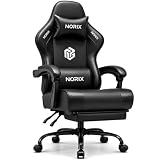


Your feet should rest flat on the floor while your knees remain near a 90-degree angle. Your lower back should touch the lumbar support without forcing you to lean forward, and there should be roughly 2 to 3 inches of space between the back of your knees and the front edge of the seat. If a chair cannot meet those conditions after adjustment, it is the wrong size even if its weight rating looks suitable.
Standard Sizes
The following measurements describe common gaming-chair size categories. Actual dimensions vary by brand, cushioning, armrests, and whether the chair has a bucket-style seat. Check the manufacturer’s specification sheet before buying, especially if you are unusually tall, short, broad-shouldered, or above the listed weight range.
| Chair size | Suggested user height | Seat height range | Seat width | Seat depth | Backrest height | Typical weight rating |
|---|---|---|---|---|---|---|
| Small | 4 ft 10 in–5 ft 6 in (147–168 cm) |
15.5–19 in (39–48 cm) |
18–20 in (46–51 cm) |
17–19 in (43–48 cm) |
27–30 in (69–76 cm) |
Up to 250 lb (113 kg) |
| Standard | 5 ft 4 in–6 ft 0 in (163–183 cm) |
16.5–21 in (42–53 cm) |
19–21 in (48–53 cm) |
18–20 in (46–51 cm) |
29–32 in (74–81 cm) |
Up to 275 lb (125 kg) |
| Large | 5 ft 10 in–6 ft 4 in (178–193 cm) |
18–22 in (46–56 cm) |
20–23 in (51–58 cm) |
19–22 in (48–56 cm) |
31–34 in (79–86 cm) |
Up to 300 lb (136 kg) |
| XL or tall | 6 ft 2 in–6 ft 8 in (188–203 cm) |
19.5–24 in (50–61 cm) |
22–25 in (56–64 cm) |
21–24 in (53–61 cm) |
33–37 in (84–94 cm) |
Up to 350–400 lb (159–181 kg) |
These categories overlap because proportions matter. A 6-foot user with long legs may need a large chair, while a 6-foot user with a shorter torso may be comfortable in a well-adjusted standard model. Seat depth is particularly important: a deep seat can support long thighs, but it may press behind the knees of a shorter user.
Many budget gaming chairs, including footrest-equipped models commonly priced around $70 to $85, fall into the standard category. They may advertise a high-back design, lumbar pillow, reclining backrest, and height adjustment, but those features do not automatically make the chair suitable for a tall person. Compare the actual seat and backrest measurements rather than relying on the product name.
How to Measure Your Space
- Measure your body height. Stand barefoot with your back against a wall and measure from the floor to the top of your head. Record the result in inches and centimeters if you are comparing specifications from different retailers.
- Measure your seated knee height. Sit on a firm, flat surface with your feet on the floor. Measure from the floor to the crease behind your knee. Your chair’s lowest seat setting should be close to this measurement, allowing your feet to remain planted.
- Measure thigh length for seat depth. Measure from the back of your hips to the crease behind your knee. Subtract about 2 to 3 inches, or 5 to 8 cm. The result is a useful target for the chair’s usable seat depth.
- Measure your hip width. Sit normally and measure across the widest part of your hips or thighs. Add at least 2 inches, or 5 cm, for comfortable clearance. Include the chair’s side bolsters if they curve inward.
- Measure shoulder width. Measure across your shoulders at their widest point. A backrest should be wider than your shoulders, and its upper wings should not push your arms forward.
- Check desk compatibility. Measure the underside of your desk. At your preferred sitting height, the armrests should slide under the desk or sit close enough for your elbows to remain around 90 degrees. A chair with a 24-inch or higher seat may not work with a low desk.
- Measure the footprint. Allow approximately 28 to 32 inches (71 to 81 cm) of width and 28 to 32 inches of depth for the chair base and casters. Add extra clearance behind the chair if you plan to recline.
- Account for accessories. Footrests extend forward, while reclining backs extend backward. Leave at least 12 inches (30 cm) in front of the chair for a footrest and 8 to 12 inches (20 to 30 cm) behind it for reclining, depending on the model.
By Room or Use Case
Bedroom or small desk
Choose a compact chair with a seat width of about 18 to 20 inches and a base no wider than roughly 28 inches. A short or standard user may benefit from a minimum seat height near 16 inches. Avoid oversized XL chairs in a bedroom unless you have measured the doorways, desk opening, and space between the chair and bed.
Home office
Prioritize adjustability over racing-style appearance. Look for a seat-height range of at least 16 to 21 inches, adjustable armrests, and a seat depth that leaves 2 to 3 inches behind your knees. If you work eight hours a day, a flatter seat and breathable upholstery may be more useful than a footrest or extreme recline.
Shared gaming station
A chair used by several people needs broad adjustment ranges. A seat height of approximately 16 to 22 inches can accommodate more users, but shorter players may still need a footrest. A removable lumbar pillow can help different body types, while a seat width of 20 to 23 inches gives most adults more flexibility.
Tall-user gaming setup
Users over 6 feet should compare the backrest height, seat depth, and maximum seat height as a group. Look for at least 32 inches of backrest height, 20 inches of usable seat depth, and a seat height that lets your knees stay level with or slightly below your hips. Do not rely only on a 300- or 400-pound weight rating; that number describes structural capacity, not legroom.
Console gaming or reclining
If you recline frequently, choose a chair with a stable five-star base and enough room behind it. A footrest can be convenient for console play, but it adds length when extended and may not support your full lower legs. Check the manufacturer’s recommended user height and the footrest length before treating it as a lounge chair.
Common Sizing Mistakes
- Buying by weight capacity alone: Weight ratings help with safety, but they do not tell you whether the seat is deep enough or the backrest is tall enough.
- Ignoring the lowest seat setting: If your feet dangle, your thighs will bear excessive pressure. A footrest can help temporarily, but the chair should still fit your normal desk posture.
- Choosing a deeper seat because you are tall: Tall users often need more depth, but excessive depth can prevent shorter users from using the lumbar support correctly.
- Measuring the outside instead of the usable seat: Side bolsters and curved edges reduce the sitting area. Compare the flat cushion width, not just the widest exterior measurement.
- Forgetting armrest height: Armrests that cannot clear your desk can force your shoulders upward or prevent you from getting close to the keyboard.
- Assuming “high-back” means tall-user fit: High-back labels are not standardized. Verify the backrest measurement and whether the shoulder wings restrict your posture.
- Leaving no movement space: A chair may fit when upright but collide with a wall when reclined. Measure the complete range of motion before ordering.
FAQ
What size gaming chair do I need if I am 5 feet tall?
Start with a small chair or a standard chair whose lowest seat setting is about 15.5 to 17 inches. You should be able to place both feet flat on the floor and sit against the lumbar support without sliding forward. A separate footrest can improve comfort if the seat is otherwise a good match.
What size gaming chair is best for someone 6 feet tall?
Most 6-foot users fit a standard or large chair. Look for a seat height of about 18 to 22 inches, a usable seat depth of 19 to 22 inches, and a backrest at least 31 inches high. Measure your knee height and thigh length before choosing between the two categories.
Do gaming chairs have a maximum height?
They do not have one universal maximum, but each model has a practical height range. Many standard chairs become uncomfortable above about 6 feet 2 inches because the seat is too short or the headrest sits below the neck. Tall or XL models are usually a better starting point for users above that height.
How much room should I leave around a gaming chair?
Plan for a footprint of roughly 28 to 32 inches wide and deep, then add clearance for movement. Leave at least 12 inches in front for a pull-out footrest and 8 to 12 inches behind for reclining. For a desk setup, keep enough side clearance to roll out without hitting walls, cabinets, or other furniture.