Key takeaways
- Apple: AirPods Pro 2 and AirPods Max offer the smoothest automatic behavior inside the Apple ecosystem. Siri, automatic device switching and personalized settings are strongest with Apple hardware.
- Bose: The Bose app works across iOS and Android and makes custom listening modes easy to save. Physical or capacitive controls can be preferable when you are wearing gloves, but control layouts take practice.
- Sony: The Sony app provides the deepest configuration, including ambient-level adjustment, voice prioritization and activity-based behavior. It is the best choice for people who want to tune rather than simply enable a feature.
The best adaptive transparency headphones overall are the Apple AirPods Pro 2 for the most natural automatic transitions, while Bose QuietComfort Ultra Earbuds are better for loud, unpredictable environments and the Sony WF-1000XM5 suit Android listeners who want extensive manual control.
Quick comparison
| Model | How it adapts outside sound | Battery life | Best compatibility | Typical market range |
|---|---|---|---|---|
| Apple AirPods Pro 2 | Adaptive Audio blends Transparency and noise cancellation; Conversation Awareness lowers media when you speak | Up to 6 hours per charge; up to 30 hours with case | Best with iPhone, iPad and Mac; works with Android as basic Bluetooth earbuds | Usually $180–$250 |
| Bose QuietComfort Ultra Earbuds | Aware mode with ActiveSense automatically suppresses sudden loud sounds without fully blocking the environment | Up to 6 hours; less with Immersive Audio enabled | iOS and Android through the Bose app | Usually $200–$300 |
| Sony WF-1000XM5 | Adaptive Sound Control changes noise-control behavior using location and activity settings; ambient sound is adjustable rather than seamlessly blended by default | Up to 8 hours with noise cancellation; up to 24 hours with case | iOS and Android, with the fullest controls on both platforms | Usually $220–$300 |
| Apple AirPods Max | Adaptive Audio balances Transparency and noise cancellation; Conversation Awareness reduces playback during speech | Up to 20 hours with noise cancellation enabled | Best with Apple devices; limited feature support on Android | Usually $450–$550 |
What “adaptive transparency” should feel like
Ordinary transparency mode simply feeds microphone sound into your ears at a fixed level. Adaptive transparency is more selective. It should let through speech, traffic and room ambience while reacting to a bus, vacuum cleaner, motorcycle or slammed door before that sound becomes uncomfortably sharp.
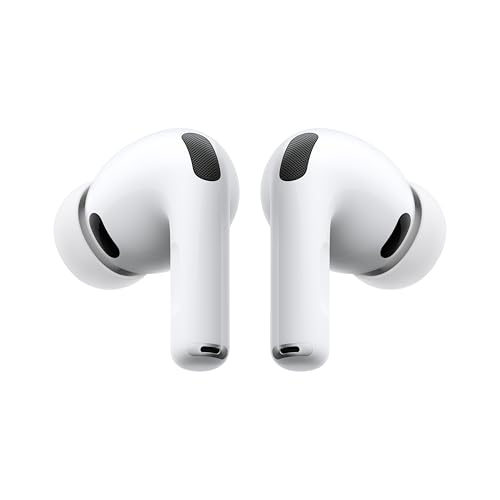
Apple AirPods Pro 3 Wireless Earbuds with Active Noise Cancellation
Included for 'Best Adaptive Transparency Headphones' as a relevant option in this category; details come from the product listing.
View on Amazon
Apple AirPods Pro (2nd Generation) Wireless Ear Buds with USB-C Charging, Up to 2X More Active Noise Cancelling Bluetooth Headphones, Transparency Mode, Adaptive, Personalized Spatial Audio, White
Included for 'Best Adaptive Transparency Headphones' because the listing specifies Up to 2X More Active Noise Cancelling Bluetooth Headphones and Transparency Mode, details this guide uses to compare options.
View on AmazonThe most useful systems do not merely make the outside world louder or quieter. They combine microphones, noise cancellation and software decisions based on sound level, speech and sometimes your location or activity. The trade-off is that aggressive processing can make voices sound slightly processed, create a brief volume dip, or fail to recognize an unusual sound. A good fit and a stable seal still matter more than the “adaptive” label.
Best overall: Apple AirPods Pro 2
AirPods Pro 2 are the easiest recommendation when “natural” adjustment is the priority. Adaptive Audio continuously blends Transparency and noise cancellation instead of forcing you to pick one mode. Conversation Awareness detects that you are speaking and lowers media while making nearby voices easier to hear.
In a café, office or train station, the transition is usually less distracting than repeatedly pressing a mode button. Transparency sounds unusually open, and the earbuds are small enough for long desk sessions. The main limitation is that Apple exposes the best adaptive controls through its own devices. Android users can pair them, but they lose much of the configuration, seamless switching and ecosystem integration.
Choose them if you use an iPhone and want to forget that sound control is running. They are also a practical choice for commuting, provided the one-earbud fit is comfortable.
Best for sudden loud noise: Bose QuietComfort Ultra Earbuds
Bose approaches adaptive transparency differently. In Aware mode, ActiveSense reduces the impact of loud environmental sounds while preserving a usable sense of the surrounding world. That makes the QuietComfort Ultra Earbuds particularly suitable for city streets, construction nearby, fitness classes and offices where equipment starts unexpectedly.
The Bose app offers more deliberate control than Apple’s system, including adjustable noise cancellation and custom modes. Sound quality is rich and the passive fit is secure when the supplied stability bands match your ears. However, the earbuds are relatively substantial, and the strongest immersive-audio features can reduce battery endurance. Voice pickup and the transparency effect may also sound less completely natural than AirPods Pro 2 in quiet conversation.
Pick Bose when protecting your ears from sudden peaks matters more than perfectly transparent speech. Keep the case nearby if you use immersive processing frequently.
Best for Android control: Sony WF-1000XM5
The Sony WF-1000XM5 are not as automatic in transparency as AirPods Pro 2. Their strength is control: the Sony app lets you tune ambient sound, prioritize voices, create location-based behavior and assign different actions to each earbud. Adaptive Sound Control can respond to activities such as sitting, walking, running or traveling.
That makes Sony a better fit for someone who wants to decide exactly what changes and when. You can build a quiet setting for a desk, a voice-forward setting for commuting and a more open setting for walking. The foam-like ear tips provide strong isolation, but they can feel warm and may exaggerate the plugged-up sensation for people who dislike sealed earbuds.
Battery life is the strongest among these in-ear options at up to eight hours with noise cancellation. Choose Sony if you use Android, value customization, or prefer longer sessions over the most invisible automatic transitions.
Best over-ear option: Apple AirPods Max
AirPods Max deliver the most spacious listening experience here because their earcups do not sit inside the ear canal. Adaptive Audio and Conversation Awareness bring the same general Apple approach to a larger headset, while the broad cushions can be more comfortable for people who dislike ear tips.
The disadvantages are physical. At roughly 386 grams, AirPods Max are much heavier than the in-ear models, and the metal construction becomes noticeable during long walks or warm commutes. They fold less compactly than many travel headphones, and the battery is rated at up to 20 hours rather than all-day-plus endurance. They are also a poor value for Android owners because several smart features depend on Apple hardware.
Choose them for flights, an office or a home workspace where full-size comfort and an expansive sound are more important than light weight.
Decision matrix by situation
| Your situation | Best choice | Why | Watch out for |
|---|---|---|---|
| iPhone user moving between quiet and noisy places | AirPods Pro 2 | Most seamless blend and useful speech detection | Shorter battery than Sony |
| Frequent sudden machinery or street noise | Bose QuietComfort Ultra Earbuds | ActiveSense softens loud peaks in Aware mode | Large earbuds and reduced runtime with extra processing |
| Android user who wants detailed automation | Sony WF-1000XM5 | Strong app-based activity, location and ambient controls | Transparency requires more tuning |
| Ear-tip fatigue or dislike of in-ear pressure | AirPods Max | Over-ear cushions avoid an ear-canal seal | Heavy, expensive and less portable |
| Long desk days with frequent conversations | AirPods Pro 2 | Conversation Awareness reduces the need to remove an earbud | Fit varies significantly between ears |
Comfort, fit and room-to-room practicality
For earbuds, compare the charging case and earbud shape with your actual routine. AirPods Pro 2 weigh about 5.3 grams per earbud, Bose QuietComfort Ultra Earbuds about 6.2 grams, and Sony WF-1000XM5 about 5.9 grams. Those differences are small on paper, but the Bose stability bands and Sony foam tips change how pressure is distributed.
Over-ear headphones are better when you wear glasses or cannot tolerate sealed tips, but check the headband and cushion contact points. AirPods Max weigh about 386 grams, compared with roughly 250 grams for many premium wireless over-ear alternatives. That extra weight is not a specification to ignore: it can create neck fatigue after several hours, especially if you work at a desk and rarely move.
Adaptive transparency also depends on microphone placement. Hair, hoods and wind can interfere with external microphones, so no model should be treated as a substitute for looking before crossing a road. In very windy conditions, a fixed lower-transparency setting can sound more natural than maximum openness.
Controls and compatibility differences
- Apple: AirPods Pro 2 and AirPods Max offer the smoothest automatic behavior inside the Apple ecosystem. Siri, automatic device switching and personalized settings are strongest with Apple hardware.
- Bose: The Bose app works across iOS and Android and makes custom listening modes easy to save. Physical or capacitive controls can be preferable when you are wearing gloves, but control layouts take practice.
- Sony: The Sony app provides the deepest configuration, including ambient-level adjustment, voice prioritization and activity-based behavior. It is the best choice for people who want to tune rather than simply enable a feature.
Which adaptive transparency headphones should you buy?
Buy the AirPods Pro 2 if natural automatic transitions and iPhone integration are your priorities. Buy the Bose QuietComfort Ultra Earbuds if unpredictable loud sounds are the main problem. Buy the Sony WF-1000XM5 if you use Android or want to customize every part of the experience. Choose the AirPods Max only when over-ear comfort and spacious sound justify the extra weight and cost.
Before ordering, confirm return eligibility and spend several sessions checking fit. Adaptive processing can improve outside-sound control, but the best model is the one whose ear tips or cushions stay comfortable long enough for you to keep the feature enabled.