Key takeaways
- Musty smell: Choose more activated carbon, clean or remove damp textiles, and inspect walls, floors, drains, and stored boxes.
- Relative humidity above 50%: Use a dehumidifier sized for the basement. A purifier will not lower humidity.
- Visible mold: Fix the moisture source first. Large areas, recurring growth, or contaminated porous materials may require professional remediation.
- Carbon monoxide or radon: Use dedicated detectors and mitigation systems. An air purifier is not a safety monitor.
The best air purifiers for basements are those with a true HEPA filter, enough clean-air delivery for the room’s square footage, and a sealed design that can handle odor without pretending to fix excess humidity or active mold.
Quick picks by basement situation
| Basement situation | Best purifier type or pick | What matters most | Typical cost |
|---|---|---|---|
| Small finished room, up to 150 sq. ft. | Levoit Core 300S or a similar compact HEPA purifier | Low noise, small footprint, affordable replacement filter | Usually $100–$180 |
| Bedroom or office, 150–300 sq. ft. | Coway Airmega AP-1512HH or Winix 5500-2 | CADR around 200–250 CFM, washable prefilter, odor control | Usually $150–$250 |
| Large open basement, 300–600 sq. ft. | Blueair Blue Pure 211i Max or another high-CADR unit | At least 350 CFM of smoke CADR; placement and airflow | Usually $300–$500 |
| Pets, litter boxes, or musty stored items | HEPA purifier with a substantial activated-carbon stage | Carbon weight, washable prefilter, frequent vacuuming | Usually $150–$600 |
| Damp or visibly moldy basement | HEPA purifier plus a properly sized dehumidifier | Humidity control, leak repair, and source removal | Usually $250–$900 for both devices |
How much purifier capacity does a basement need?
Basements are often harder to clean than bedrooms because they have lower air circulation, concrete surfaces, storage clutter, and sometimes an open stairwell. Choose by the purifier’s clean-air delivery rate (CADR), not only by the manufacturer’s advertised room-size figure.

Air Purifiers for Home Large Room up to 2200sq.ft, MOOKA Air purifier for Home Pets with Washable Filter, PM 2.5 Display Air Quality Sensor Air Cleaner for Bedroom, Dorm room, Pets, Office PR1 (White)
Included for 'Best Air Purifiers for Basements' because the listing specifies MOOKA Air purifier for Home Pets with Washable Filter and PM 2.5 Display Air Quality Sensor Air Cleaner for Bedroom, details this guide uses to compare options.
View on Amazon
LEVOIT Smart Air Purifier for Home Large Room up to 1875 Ft² Vital 200S-P
Included for 'Best Air Purifiers for Basements' as a relevant option in this category; details come from the product listing.
View on Amazon
GermGuardian HEPA Air Purifier Tower - 22" - Gray - AC4825E
Included for 'Best Air Purifiers for Basements' because the listing specifies 22" and Gray, details this guide uses to compare options.
View on Amazon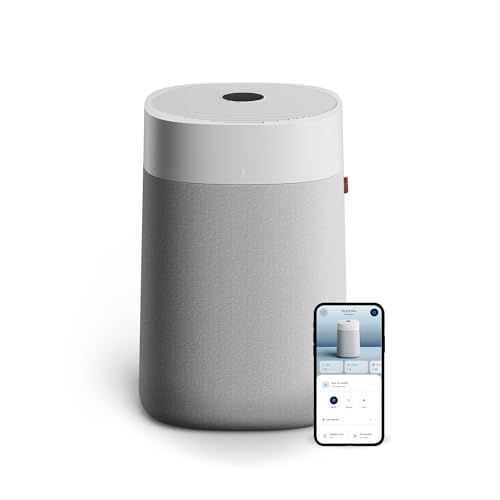
BLUEAIR Air Purifiers for Home Large Room up to 3,235 Ft², Blue 211i Max
Included for 'Best Air Purifiers for Basements' because the listing specifies 235 Ft² and Blue 211i Max, details this guide uses to compare options.
View on AmazonFor a normal 8-foot ceiling, a useful target is approximately 4 to 6 air changes per hour (ACH). A simple estimate is:
Required CADR in CFM = room length × width × ceiling height × desired ACH ÷ 60
For example, a 10-by-12-foot basement room with an 8-foot ceiling contains 960 cubic feet. At 5 ACH, it needs about 80 CFM of delivered clean air. A purifier rated around 200 CFM gives useful headroom for a closed room, while a unit advertised for 1,000 square feet may not perform as expected if that claim assumes only one or two air changes per hour.
If the basement is open to the stairway, has a furnace room, or is divided by walls, use two medium units or choose a larger purifier rather than relying on one device at the top of the stairs. Oversizing also lets you use a quieter fan speed.
Best options by basement size
For a small basement room: Levoit Core 300S
The Levoit Core 300S is a practical choice for a finished office, hobby room, or guest room of roughly 100–180 square feet. Its compact cylindrical body is easy to place beside a wall without consuming much floor space, and its app and automatic mode are useful if you want scheduled operation.
It is better suited to particle removal than to strong basement odors. Its carbon layer is relatively modest, so it may reduce light mustiness but will not compete with a purifier containing several pounds of carbon. Expect replacement filters to cost roughly $25–$50, depending on the filter version and seller. Verify the exact replacement before buying because different Core models use different cartridges.
For a medium room: Coway Airmega AP-1512HH
The Coway Airmega AP-1512HH remains a well-balanced medium-room option. It combines a washable prefilter, particle filtration, and an odor-reducing carbon layer. A room around 10 by 12 feet is comfortably within the range where this class of purifier makes sense, particularly when the door is closed.
The washable prefilter is valuable in a basement because lint, dust, pet hair, and storage debris can load the main filter quickly. Clean it about every two weeks in a dusty environment and let it dry completely before reinstalling it. Replacement filters commonly fall in the $40–$70 range. The unit is light enough for one person to move, but leave room around the intake rather than wedging it behind furniture.
For pets and odor: Winix 5500-2
The Winix 5500-2 is a strong fit for a basement with pets, litter boxes, or dusty fabric furniture. Its washable fine-mesh prefilter and carbon filter made with pelletized carbon give it a more useful odor-control setup than many budget purifiers with only a thin carbon sheet.
Its optional ionization feature can be turned off if you prefer mechanical filtration only. For a basement, place it near the odor source but not directly beside a litter box, utility sink, or damp wall. The purifier can capture airborne particles; it cannot remove odor absorbed into carpet, drywall, or stored cardboard.
For a large open basement: Blueair Blue Pure 211i Max
The Blueair Blue Pure 211i Max is appropriate when the basement is a large recreation area or an open 300–600-square-foot space. Its high airflow gives it more capacity than compact bedroom units, and its washable prefilter sleeve can catch larger dust and hair before they reach the main filter.
Its filtration design is not the same as a conventional thick, tightly sealed HEPA box, so compare the manufacturer’s particle-CADR and filtration claims with your priorities. It is particularly attractive when you need a high volume of cleaned air at moderate fan speeds. Replacement filters are often around $60–$100.
Odor, humidity, and mold are separate problems
A purifier is useful for airborne dust, smoke, pollen, pet dander, and some particles associated with mold. It is not a dehumidifier, leak detector, or mold-remediation machine.
- Musty smell: Choose more activated carbon, clean or remove damp textiles, and inspect walls, floors, drains, and stored boxes.
- Relative humidity above 50%: Use a dehumidifier sized for the basement. A purifier will not lower humidity.
- Visible mold: Fix the moisture source first. Large areas, recurring growth, or contaminated porous materials may require professional remediation.
- Carbon monoxide or radon: Use dedicated detectors and mitigation systems. An air purifier is not a safety monitor.
Keep a small hygrometer in the basement. A practical target is about 30%–50% relative humidity, although the appropriate level depends on climate and comfort. Running a purifier beside a dehumidifier is fine, but do not position the purifier where warm exhaust from the dehumidifier blows directly into its intake.
Noise, placement, and filter-cost trade-offs
Noise matters more downstairs because basements often contain bedrooms, media rooms, or workspaces. A purifier rated at 20–30 dB on its lowest setting may be suitable near a bed, but its useful cleaning rate will be much higher on medium or high. Automatic mode can help, although some sensors react to particles rather than odors or humidity.
Give the unit at least 12 inches of open space around its intake and exhaust; 18–24 inches is safer when the sides or rear contain the main intake. Do not place it under a desk, behind a sofa, or inside a storage cubby. For a 10-by-12-foot room, placing it near a wall with the clean-air outlet facing into the room is usually more effective than putting it in a corner.
| Feature | Lower-cost design | Better basement-oriented design | Why it matters |
|---|---|---|---|
| Particle filter | Thin pleated cartridge | True HEPA or clearly documented high-efficiency filter | Improves capture of fine dust and airborne allergens |
| Odor stage | Carbon-coated sheet | Deeper pelletized or granular activated carbon | More carbon generally provides better short-term odor adsorption |
| Pre-filter | Non-washable or minimal screen | Removable, washable mesh | Reduces hair and dust loading on the expensive filter |
| Annual filter budget | About $30–$80 | About $60–$150 or more | High-CADR units often use larger, costlier filters |
A practical buying checklist
- Measure the actual enclosed area and ceiling height.
- Prefer published CADR figures, especially smoke CADR, over vague “up to” room claims.
- Choose a washable prefilter if the basement has pets, fabrics, or heavy dust.
- Look for a substantial carbon stage if odor is a priority, but keep expectations realistic.
- Check replacement-filter availability and cost before purchasing the purifier.
- Confirm the operating temperature range if the basement becomes cold in winter.
- Plan for at least 12 inches of clearance and an accessible location for filter changes.
For most finished basements, a medium purifier such as the Coway Airmega AP-1512HH or Winix 5500-2 offers the best balance of airflow, noise, maintenance, and operating cost. Choose a compact Levoit Core 300S for a small closed room, step up to a high-CADR unit such as the Blueair Blue Pure 211i Max for an open basement, and treat humidity or mold at the source rather than expecting any purifier to solve it.