Key takeaways
- Choose a weight that permits at least 10 technically sound repetitions.
- Measure the training area, not just the storage space. Leave approximately 6 feet between you and the wall plus 3 feet behind you.
- For apartments, prioritize a low-bounce, soft-shell ball to reduce noise and accidental ricochets.
- Inspect the seam pattern and stitching density, especially around the handle-free panels where impact is concentrated.
- Check whether the listed diameter matches your target. A larger ball can be harder to control even at the same weight.
- Confirm that the ball is intended for wall throws. A medicine ball labeled only for slams may have a different shell and rebound profile.
- Use a rated wall target or solid masonry surface; drywall, glass, doors, and thin partition walls are poor throw targets.
The best wall balls for most home and gym workouts are soft, stitched medicine balls with a consistent 14-inch diameter, a reinforced shell, and a weight that lets you throw to target height without losing control.
Best wall balls by training situation
| Situation | Best choice | Why | Weight starting point |
|---|---|---|---|
| Small apartment or low ceiling | Compact, 9-inch wall ball | Needs less clearance and is easier to catch close to the body | 4–8 lb |
| General home fitness | 14-inch stitched wall ball | Stable flight, forgiving catches, and broad exercise versatility | 8–14 lb |
| Cross-training and high-repetition circuits | Reinforced 14-inch ball with a dense fill | Better shape retention and predictable rebounds | 12–20 lb |
| Partner throws | Soft-shell ball with low-to-moderate rebound | Safer for chest passes and catches at changing distances | 6–12 lb |
| Strong athletes and gym use | Heavy-duty ball with double stitching | Handles frequent impacts against a suitable wall or target | 16–30 lb |
What separates the best wall balls?
Weight: choose control before ambition
Wall-ball weight is normally listed in pounds, with common options from 4 to 30 lb. A suitable ball should allow you to complete a set of 10 to 20 throws while keeping your ribs stacked over your pelvis and your catch controlled. If the ball pulls you forward, makes you arch your back, or causes the target height to drop, it is too heavy for conditioning work.
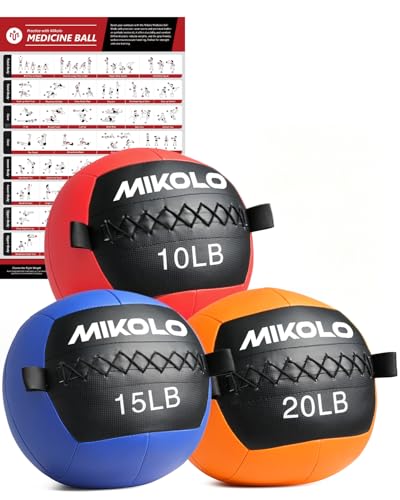
Mikolo Medicine Ball, Wall Ball,Soft Medicine Ball Set,Slam Ball for Core Training, Strength Workouts -Multi-Weight 10lbs 20lbs Exercise Balls for Home Gym, Functional Fitness (10/15/20LB)
Included for 'Best Wall Balls for Home and Gym Workouts' because the listing specifies Wall Ball and Soft Medicine Ball Set, details this guide uses to compare options.
View on Amazon
Titan Fitness 20 lb Soft Leather Medicine Wall Ball, Brown Color-Coded
Included for 'Best Wall Balls for Home and Gym Workouts' because the listing specifies Brown Color-Coded, details this guide uses to compare options.
View on Amazon
Mikolo Medicine Ball, Wall Ball,Soft Medicine Ball Set,Slam Ball for Core Training, Strength Workouts -Multi-Weight 10lbs 20lbs Exercise Balls for Home Gym, Functional Fitness (10LB)
Included for 'Best Wall Balls for Home and Gym Workouts' because the listing specifies Wall Ball and Soft Medicine Ball Set, details this guide uses to compare options.
View on Amazon
JFIT Soft Wall Ball – Non-Slip Medicine Ball for Crossfit, Strength Training, Plyometrics & Core Workouts – Durable & Balance Tested - 20 LB, Red/Black
Included for 'Best Wall Balls for Home and Gym Workouts' because the listing specifies Non-Slip Medicine Ball for Crossfit and Strength Training, details this guide uses to compare options.
View on AmazonFor general strength circuits, 8–14 lb is a useful range for many adults. A 4–8 lb ball is more practical for beginners, younger users, and rapid partner drills. Larger athletes may prefer 14–20 lb for squats and throws, while 20 lb or more is usually a specialist choice rather than the best all-purpose home option.
Remember that the ball’s diameter changes how heavy it feels. A 14-inch ball is awkward to hold against the chest, so a 10 lb, 14-inch ball can feel more demanding than a compact 10 lb medicine ball during squats and carries.
Diameter and room clearance
Fourteen inches is a common wall-ball diameter because it resembles the large target used for wall-ball squats. It is easy to catch with both hands, but it needs more room than a standard medicine ball. Compact balls around 9 inches are easier to store and move quickly, although they feel less forgiving when caught at speed.
In a 10-by-12-foot room, a 9-inch or 10-inch ball is usually easier to use without striking furniture. A 14-inch ball can still work, but position yourself at least 6 feet from the wall and leave roughly 3 feet behind you for a safe step-back. Remove coffee tables, desk chairs, floor lamps, and loose rugs from the landing area. For overhead throws, allow at least 18 inches of clearance above the intended release path; a low ceiling may make controlled chest passes more suitable than high wall throws.
Do not substitute a 14-inch wall ball for a small slam ball in a narrow room. The larger ball needs a clean catching lane, and its soft exterior does not make collisions with televisions, windows, or furniture harmless.
Shell durability and construction
A wall ball typically has a synthetic leather, vinyl, or rubberized outer shell wrapped around a textile or foam-filled core. Look for multiple stitched panels, reinforced seams, and a filling that does not shift noticeably when the ball rotates. Heat-welded seams can be durable, but stitching makes repairs and seam quality easier to inspect.
| Construction feature | Advantages | Trade-off | Best use |
|---|---|---|---|
| Stitched synthetic leather or vinyl | Soft catch, good hand comfort, broad range of sizes | Can scuff or split if used on rough concrete | Indoor wall throws and partner work |
| Rubberized outer shell | Resists moisture and surface abrasion | Often firmer and less comfortable on catches | Busy gyms and mixed indoor training |
| Foam-filled core | Quiet impact and predictable, limited bounce | May compress permanently under repeated heavy use | Wall targets, squats, and partner drills |
| Loose or granular fill | Can create a more dynamic, shifting load | Less predictable flight and shape over time | Specialized conditioning, not precision throws |
| Double-stitched panels | Improved seam longevity under repeated impact | Usually costs more and may feel slightly firmer | High-frequency gym circuits |
For a home ball, synthetic leather with reinforced stitching is usually the best balance. Avoid using a soft wall ball on brick, unfinished concrete, or a wall with sharp edges. Those surfaces can abrade the shell faster than normal training does.
Bounce and grip: important differences in real workouts
A wall ball should have a controlled rebound rather than a lively bounce. When the ball returns too quickly, it can hit the face or force you to catch with extended elbows. When it barely rebounds, repeated throws become slower and more tiring. For wall-ball squats, a limited, consistent rebound is preferable because it lets you reset your hands without turning the exercise into a reaction drill.
Grip depends on both surface texture and hand size. Lightly textured vinyl is comfortable for sweaty hands and barehanded catches. Very smooth surfaces become slippery during long circuits, while deeply pebbled rubber may irritate the palms. A 14-inch ball is easier to cradle but harder to squeeze securely; a compact ball provides a firmer handhold but demands more precise catches.
Do not confuse a wall ball with a slam ball. Slam balls are usually denser, smaller, and designed to be dropped forcefully. They can be unpleasant or unsafe for chest catches and may rebound unpredictably from a wall. Choose a wall ball for repeated throws and catches; choose a slam ball for controlled floor slams.
Head-to-head: compact versus full-size wall balls
Compact wall balls
Compact balls around 9 inches are the better choice when storage, speed, and room size matter. They fit more easily on a shelf, are less likely to strike a ceiling, and work well for rotational throws, partner chest passes, and single-arm movements. Their smaller catching surface requires more accuracy, and they may not reproduce the feel of a standard wall-ball target.
Full-size wall balls
Full-size balls around 14 inches are more forgiving during catches and better for wall-ball squats, overhead tosses, and beginner technique. Their broad surface also distributes impact across both hands. The disadvantages are bulk, slower movement, and a greater chance of damaging nearby objects if your throw misses.
Buying checklist for home and gym use
- Choose a weight that permits at least 10 technically sound repetitions.
- Measure the training area, not just the storage space. Leave approximately 6 feet between you and the wall plus 3 feet behind you.
- For apartments, prioritize a low-bounce, soft-shell ball to reduce noise and accidental ricochets.
- Inspect the seam pattern and stitching density, especially around the handle-free panels where impact is concentrated.
- Check whether the listed diameter matches your target. A larger ball can be harder to control even at the same weight.
- Confirm that the ball is intended for wall throws. A medicine ball labeled only for slams may have a different shell and rebound profile.
- Use a rated wall target or solid masonry surface; drywall, glass, doors, and thin partition walls are poor throw targets.
Price and durability expectations
Basic home wall balls generally cost about $40–$90, while heavily reinforced or commercial-grade models often fall around $90–$180. The higher price is most justified when several people will use the ball daily. In a home gym, correct weight selection and a suitable wall usually matter more than buying the thickest available shell.
The first parts to wear are commonly the outer texture, seam thread, and panel corners. Store the ball away from direct sunlight, wipe sweat from the shell, and avoid leaving it compressed under heavy equipment. If the ball develops a soft spot, leaking fill, an open seam, or a noticeably altered flight path, retire it rather than continuing high-speed throws.
Bottom line
Choose a 14-inch, reinforced stitched wall ball in the 8–14 lb range for the most versatile home setup. Pick a compact 4–8 lb model for a small room or fast partner drills, and move to a double-stitched 14-inch ball at 16 lb or more only when your technique and available clearance support it. The best wall balls are not simply the heaviest or most expensive: they are the ones with predictable bounce, secure grip, durable seams, and enough room around them for every repetition to remain controlled.