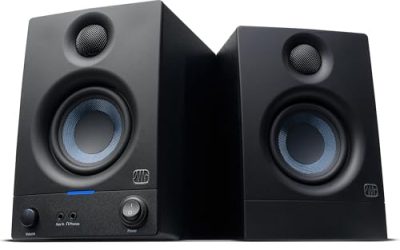
Our Top Picks
 PreSonus Eris 3.5 Bluetooth Powered Desktop Studio Monitors3.5" Bluetooth5.5 x 6 x 8.3 Inches1.4 PoundsCheck on Amazon
 PreSonus Eris 3.5 Powered Desktop Studio Monitors3.5" Monitor6 x 5.5 x 8.3 Inches6.83 PoundsCheck on Amazon
Choosing speakers for music production is a different problem from choosing speakers for movies. You want a pair that shows flaws in a kick drum or a muddy vocal, not one that hides them with extra bass. With a desk setup in mind, the sensible shortlist is powered near-field monitors: two speakers with their own built-in amplifiers that connect straight to an audio interface. This guide compares five pairs from the listings, with duplicate color variants merged so you are not comparing the same speaker twice.
It is aimed at beginners building a first home studio and at working producers who need a second reference pair. The main decisions are woofer size, whether wireless streaming matters to you, and how many inputs the cabinet offers. For 2026 buying, even compact models now list Bluetooth, so the real question is whether you want it on the same speakers you mix with or prefer to keep your monitoring wired and simple.
Quick Picks

PreSonus Eris 3.5 Powered Studio Monitors, Pair — 3.5” Active Near | -Field Desktop Speakers for Music Production, Gaming, Movies & Hi-Fi | 50W, Woven-Composite Woofer, Silk-Dome Tweeter, Black
One of the consumer electronics options compared in this guide.
View on Amazon
Ortizan C7 Powered Studio Monitors Pair with Bluetooth 5.3, White | FOR HOME STUDIOS – Compact active monitors for music production, content creation, gaming and desktop audio.
One of the consumer electronics options compared in this guide.
View on Amazon
Ortizan C7 Powered Studio Monitors Pair with Bluetooth 5.3, Black | FOR HOME STUDIOS – Compact active monitors for music production, content creation, gaming and desktop audio.
One of the consumer electronics options compared in this guide.
View on AmazonPreSonus Eris 3.5 Bluetooth Powered Desktop Studio Monitors Pair- 50W Black | 3.5" Active Near-Field Desktop Speakers for Music Production, Gaming, Movies & Hi-Fi,Woven-Composite Woofer,Silk-Dome Tweeter
One of the consumer electronics options compared in this guide.
View on AmazonPreSonus Eris 3.5 Powered Desktop Studio Monitors, Pair – 50W, White | 3.5" Active Near-Field Desktop Speakers for Music Production, Gaming, Movies & Hi-Fi,Woven-Composite Woofer,Silk-Dome Tweeter
One of the consumer electronics options compared in this guide.
View on Amazon| Product | Best for | Key spec taken from the product title |
|---|---|---|
| PreSonus Eris 3.5 | Wired, no-frills small desk setup | 3.5″ active near-field pair, 50W |
| PreSonus Eris 3.5 Bluetooth | Same size with wireless playback | Bluetooth, 3.5″ active near-field, 50W |
| Ortizan C7 | Home studio plus content creation | Bluetooth 5.3 powered monitors |
| PreSonus Eris E4.5 | Extra low-end information | 4.5″ two-way near-field pair |
| Edifier MR4.5 | Maximum input flexibility | 80W RMS, bi-amped, Bluetooth 6.0 LDAC |
How to Choose
Start with the room, not the speaker
A spare bedroom with bare walls colors sound more than a small difference in tweeter material. Before buying, measure your desk depth. Near-field monitors are designed to be about three feet from your head. In a room under roughly ten by twelve feet, 3.5 to 4.5-inch woofers are the practical range, because larger drivers excite the room’s low-frequency resonances without giving you more usable information.
A practical test is the desk itself: sit where you normally work, extend your arms, and imagine a speaker at each fingertip. If that triangle already crowds your keyboard and screen, choose the smaller woofer and gain clarity from placement rather than from size. Good placement is free; extra cabinet volume is not.
Look for balanced inputs and a level control
Producers connect through an audio interface, and balanced XLR or TRS cables keep hum out of that path. A cabinet that offers only RCA or a 3.5 mm jack will work, but it is built more for desktop media than for a studio chain. A front-facing volume knob or a rear level trim also saves you from reaching behind the speaker constantly.
Also check how the pair is linked. In many powered sets one speaker holds the amplifier and inputs while the second connects by a supplied cable. A short speaker cable limits how wide you can space them, so look for a listing that mentions cable length or plan on a replacement run.
Treat Bluetooth as optional
Several listings highlight Bluetooth, including versions 5.3 and 6.0 with LDAC. It is useful for playing reference songs from a phone while you decide on a mix direction. It does not improve the monitoring itself, and the wireless stream is compressed. If you will never stream, a wired model avoids paying for a feature you ignore.
One more point: wireless links add latency. That delay is harmless for music playback but makes Bluetooth unsuitable for recording along to a track or syncing audio to video, where a wired connection keeps timing locked.
Where budget pairs cut corners and what to ignore
Peak-power numbers and glossy marketing words mean little at desk distance. Cheap pairs often drop the balanced inputs, supply a short interconnect cable, or use a single amplifier for both drivers. A dome or silk tweeter and a bi-amped design are better signals of care. Also ignore cabinet color; it changes nothing about the sound.
Finally, remember that no monitor fixes a bad room. A rug under the desk or a pair of isolation pads will change what you hear more than a small gap between two similar speaker models. Spend part of the budget on those if you can.
Several of these are marketed for gaming and movies as well as production, so one pair can cover both jobs; just keep any bass boost or tone enhancement switched off while you mix. Loudness is rarely an issue at desk distance, since even a modest powered pair reaches comfortable levels and the aim is detail at low volume.
With only five distinct models on the list, the differences come down to three things: woofer size, wireless, and input variety. Read each review with those three questions in mind, and remember that the white and black versions of a speaker are interchangeable apart from looks.
It also helps to decide how you will connect before you buy. A producer using an interface with two balanced outputs should shortlist cabinets that name balanced inputs. A creator plugging straight into a laptop headphone jack will care more about the 3.5 mm auxiliary input and Bluetooth, and can safely pick a simpler pair.
The 5 Best Options
PreSonus Eris 3.5
This is the straightforward wired version: a pair of 3.5-inch active near-field speakers rated at 50W, marketed for music production, gaming, movies and hi-fi. It suits a producer on a small desk who plans to connect through an interface and keep everything simple.
- Strength: Compact 3.5-inch near-field format fits tight workspaces.
- Strength: Works across production and entertainment duty.
- Trade-off: Limited bass depth because of the small woofers.
Skip it if you make bass-heavy genres and cannot add a subwoofer. Anyone working on electronic or hip-hop material will want a way to check the low octaves, and that means either headphones or a sub next to this pair.
PreSonus Eris 3.5 Bluetooth
The Bluetooth edition keeps the 3.5-inch active near-field design and 50W rating and adds wireless connection. It suits a producer who also wants to stream a playlist from a phone without changing cables, and who sits close enough for the small drivers to do the job.
- Strength: Adds wireless playback to the compact Eris layout.
- Strength: Same desk-friendly size as the wired model.
- Trade-off: Wireless features may not matter if you only mix through an interface.
Skip it if you want to avoid paying for wireless you will never use. A purely wired setup with a good cable is simpler, and the money saved can go toward isolation pads or a stand.
Ortizan C7
The C7 is described as compact active monitors with Bluetooth 5.3 for home studios and content creation. Its appeal is mixed-use flexibility: music, video editing and streaming from one desk. The color variants listed separately are the same product, so choose by desk aesthetic.
- Strength: Bluetooth 5.3 for easy phone playback.
- Strength: Compact active build suits home setups.
- Trade-off: The title gives limited driver detail to evaluate.
Skip it if you want precise driver and tweeter specs before purchase. Buyers who like to compare numbers across brands will find the listing thin next to the more detailed ones in this group.
PreSonus Eris E4.5
This model moves to a 4.5-inch two-way near-field design, still aimed at production, gaming, movies and hi-fi. It is a sensible next step for someone who finds 3.5-inch speakers thin in the low mids but does not want large studio cabinets.
- Strength: Larger woofer for fuller low-end detail.
- Strength: Two-way layout separates woofer and tweeter duties.
- Trade-off: Takes up more desk space than the 3.5-inch pairs.
Skip it if your desk is shallow or already crowded. The larger cabinets also need space behind them, so a desk pushed tight against a wall is a poor match.
Edifier MR4.5
The MR4.5 lists a bi-amped design, 80W RMS, a 4.5-inch woofer, a 1-inch silk tweeter, Hi-Res audio, Bluetooth 6.0 with LDAC and XLR, TRS, RCA and auxiliary inputs. It is the best match when you need to connect an interface, a phone and a console to the same pair. The white and black versions are identical apart from finish.
- Strength: Broad input selection suits studio and living-space use.
- Strength: Silk tweeter and bi-amped layout on paper.
- Trade-off: Larger footprint and higher power than compact rivals.
Skip it if you only need a minimal, small-desk pair. The extra inputs and the larger enclosure are wasted if you only ever connect one source in a cramped corner.
Which One Fits Your Situation
You make beats on a very small desk
The PreSonus Eris 3.5 gives you a wired, interface-friendly pair that fits where bigger speakers will not.
You want to hear reference playlists wirelessly
The PreSonus Eris 3.5 Bluetooth keeps the same size and adds phone streaming, so you can compare your mix against finished songs quickly. Keep in mind that the wired path is still the one to trust for judging balance.
You create video and music in the same room
The Ortizan C7 is built around home studios and content creation, with Bluetooth 5.3 for convenience between editing sessions.
You want room to grow with multiple sources
The Edifier MR4.5 handles balanced, unbalanced and wireless connections, so it stays useful as your gear list expands. It also makes sense for a shared room where a housemate streams music while you reserve the wired input for sessions.
You share the desk with a gaming setup. The PreSonus Eris E4.5 is listed for gaming and movies alongside production, and its 4.5-inch two-way layout gives explosions and film scores a little more weight while still working as a monitor.
You edit podcasts or voiceover as well as music. The Ortizan C7 keeps cost and footprint down while still covering content creation work, which makes it an easy fit for spoken-word editing beside music sessions.
You want one pair to cover movies after a session. The PreSonus Eris E4.5 is listed for movies and hi-fi alongside production, so evenings of film do not require a second set of speakers.
Common Mistakes
- Counting color variants as different products and wasting time comparing identical speakers.
- Judging a monitor by how exciting it sounds instead of how revealing it sounds.
- Placing the pair too far apart or too close to the back wall.
- Using Bluetooth for mixing decisions when a wired connection is available.
- Skipping stands or isolation pads, which lets desk vibration muddy the bass.
Related guides
- Aio Liquid Coolers For High Performance Gaming
- Gaming Chair Accessories And Replacement Parts
- Video Doorbell Cameras Without Subscription
Frequently Asked Questions
Do I need studio monitors, or will regular speakers do?
Regular speakers often boost bass and treble to sound pleasing. Monitors aim for a flatter presentation so mix problems are easier to hear.
Is a 3.5-inch woofer too small for music production?
For a small room and near-field listening, it can work for arranging, vocals and editing. For bass-focused genres, add headphones or a subwoofer for low-end checks.
Why are some listings duplicated in different colors?
The same speaker is often sold in black and white. The specs are unchanged, so pick the finish that suits your desk.
Do I need an audio interface?
Models with balanced inputs pair best with an interface. Models with a 3.5 mm or RCA input can connect directly to a computer, though with less flexibility.