Our Top Picks
 Uncaged Ergonomics WorkEZ Adjustable Monitor Stand Riser for18x11" panel11 x 2 x 19 inches3.3 poundsCheck on Amazon
To set up a monitor ergonomically, place it 20 to 40 inches (50 to 100 cm) from your eyes, with the top edge at or slightly below eye level and the screen tilted slightly back so it faces you squarely. Sit first, adjust the chair and desk, then move the monitor to fit your seated posture, not the other way around.
The numbers, in one table
These figures come from OSHA’s computer workstation guidance on monitors.

THE ERGONOMIC MONITOR SETUP GUIDE FOR SENIORS: How To Install, Adjust, And Position 13–32 Inch Vesa Monitor Stands For Better Posture And Reduced Neck & Back Strain.
Chosen because it specifies Adjust and And Position 13.
View on AmazonUncaged Ergonomics WorkEZ Adjustable Monitor Stand Riser for Desk, Black | Aluminium computer riser, 16 x 11 in panel that rotates 360, holds up to 13 lb, folds flat at 3.1 lb.
Chosen because it specifies Black and Aluminium computer riser.
View on Amazon
HUANUO 17-32 Inch Dual Monitor Stand, Stacked Monitor Mount, Monitor Arms for 2 Monitors, Ergonomic Adjustable Tilt/Swivel/Rotate, Weight Max 19.8 lbs, VESA 75/100mm
Chosen because it specifies Stacked Monitor Mount and Monitor Arms for 2 Monitors.
View on Amazon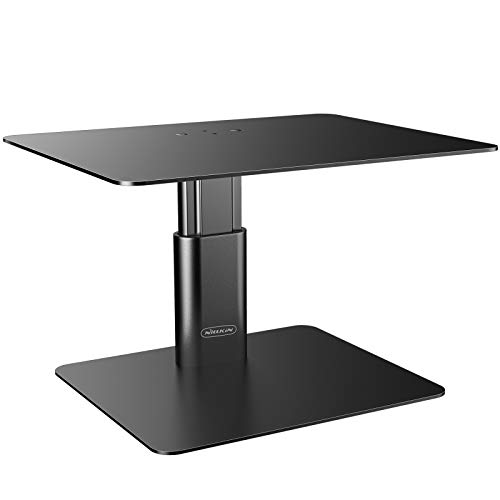
Nillkin Monitor Stand for Desk, Adjustable Height Computer Monitor Stand | Ergonomic Aluminum Computer Stand for Desktop | iMac, Studio Display XDR, Dell, HP, Lenovo, Other Screen Display | Black
Chosen because it specifies Adjustable Height Computer Monitor Stand and Ergonomic Aluminum Computer Stand for Desktop.
View on Amazon| Setting | Stated guideline | Why it matters |
|---|---|---|
| Viewing distance | 20 to 40 inches (50 to 100 cm) from eye to screen | Avoids leaning forward or squinting |
| Height | Top of the screen at or slightly below eye level; screen center about 15 to 20 degrees below horizontal eye level | Keeps the neck from tilting back |
| Tilt | Screen roughly perpendicular to your line of sight, often by tilting no more than 10 to 20 degrees | Reduces glare and awkward head angles |
| Glare | Place the monitor perpendicular to windows | Cuts reflections that force you to lean or squint |
| Bifocal wearers | May need the monitor lower than usual | Prevents tilting the head back to read through the lower lens |
Step-by-step setup
1. Start with your chair and desk
Sit with your feet supported on the floor or a footrest, thighs roughly level and your back supported. Bring your forearms to a comfortable, near-level position at the keyboard with relaxed shoulders. The monitor only makes sense once your seated position is settled, because eye height depends on how you sit.
2. Set the distance
Sit back in your chair and extend an arm toward the screen. Your fingertips should touch the display or come close. That is a quick way to land in the 20 to 40 inch range. A larger or higher-resolution monitor usually needs more distance so you can see the whole screen without turning your head. If you have to lean toward the text, increase the text size in the operating system instead of moving the monitor closer.
3. Set the height
Look straight ahead with your head upright. The top edge of the viewable area should be at or just below eye level. If the monitor is too low, you will bend the neck forward; if it is too high, you will tilt the chin up. Use a stand with height adjustment, a monitor arm, or a stable platform. Books work temporarily but are unstable, so use something sturdy.
4. Set the tilt and angle
Tilt the top of the screen slightly away from you so the surface faces your eyes, within roughly the 10 to 20 degree range that OSHA mentions. Then turn the screen left or right until it sits straight in front of you. Large monitors and curved panels can be harder to aim; centering your main working area at the middle of the screen helps.
5. Deal with glare and lighting
Position the screen at right angles to windows so daylight does not shine directly on it or into your eyes. OSHA notes that tilting a screen back can reveal ceiling light reflections, in which case an anti-glare approach or a lighting change may be needed. Lowering the monitor brightness to match the room and reducing harsh overhead light are practical adjustments. Avoid having a bright window directly behind the screen.
6. Set text size and brightness
Adjust text scaling so you can read comfortably without leaning. Match monitor brightness to the room so the screen is not a glowing patch in a dark room or washed out in a bright one. The exact controls vary by monitor, so use the on-screen menu described in the manual.
Layouts for different setups
| Setup | Placement tip |
|---|---|
| Single monitor | Center it directly in front of you at the height and distance above |
| Two monitors, both used equally | Place them side by side with the join at the center, angled slightly inward |
| Two monitors, one primary | Center the main one and place the second off to the side at a slight angle |
| Ultrawide or curved | Center the screen so the middle sits in front of you; keep the top edge near eye level |
| Laptop as a desk screen | Raise it on a stand and add a separate keyboard and mouse so the screen can be at eye level |
| Standing desk | Re-adjust height whenever you switch position; a monitor arm makes this easier |
Gaming-specific tips
Long gaming sessions tempt people to lean forward. If you play with a controller on a couch, the same distance principle applies, with the screen at a comfortable height so you do not tilt your head. On a desk, mouse and keyboard users should keep elbows near the body and wrists neutral, and the monitor should not force them to reach. Take short breaks to stand, stretch and look at something distant. Many guides suggest looking away from the screen periodically to reduce eye strain, and an eye care professional can advise on glasses suited to screen use.
Common mistakes
- Placing the monitor on top of a stack that puts the top edge well above eye level.
- Leaving the screen too close because the text is small, instead of enlarging text.
- Angling the monitor to one side of a desk so the neck twists for hours.
- Ignoring window glare and compensating by leaning forward.
- Setting everything once and never adjusting after changing chairs or desk height.
- Wearing multifocal glasses without lowering the screen, forcing the head back.
Quick checklist
- Feet supported, back supported, shoulders relaxed.
- Arm’s length from the screen as a starting point.
- Top edge at or just below eye level.
- Slight tilt back; screen faces your eyes.
- No direct window glare or reflections.
- Text large enough to read without leaning.
- Regular breaks and posture changes.
If you have persistent neck, shoulder, wrist or eye discomfort, speak to a doctor or an occupational health professional; a setup guide cannot replace individual advice.
Frequently Asked Questions
How far should my monitor be from my eyes?
OSHA’s guidance lists 20 to 40 inches (50 to 100 cm) from the eye to the front of the screen. A common starting point is arm’s length, adjusted to what is comfortable for your screen size.
Should the top of the monitor be at eye level?
The guidance says the top of the monitor should be at or slightly below eye level, with the screen center about 15 to 20 degrees below horizontal eye level. This keeps the head neutral instead of tilted up.
Should I tilt my monitor?
A slight tilt back so the screen faces your eyes is usually appropriate, within roughly 10 to 20 degrees according to OSHA. Check for new glare after tilting and adjust lighting if needed.
How do I set up two monitors?
If both are used equally, center them as a pair with the join in front of you. If one is primary, put it directly in front and the other to the side at a slight angle, so you turn your eyes more than your neck.
Do I need a monitor arm?
Not always, but an arm or an adjustable stand makes height, distance and tilt easier to set. If the built-in stand cannot reach eye level, an arm or a sturdy riser is a practical fix.
Does screen brightness affect ergonomics?
Yes. A screen much brighter or dimmer than the room can strain the eyes, so match brightness to your surroundings and reduce glare. Settings menus differ by maker, so use the monitor manual to find the controls.
FAQ
How far should my monitor be from my eyes?
Should the top of the monitor be at eye level?
Should I tilt my monitor?
How do I set up two monitors?
Do I need a monitor arm?
Does screen brightness affect ergonomics?
More from Amazon
Programs that pair well with the guide above. Offers and eligibility are set by Amazon and may change.
Set up recurring deliveries of everyday items on eligible products. Terms and savings are set by Amazon.
Explore Subscribe & SaveFree shipping on eligible items, Prime Video and more. Eligible new members can start with a free trial.
Start a Prime free trialA Prime membership for ages 18-24 with a trial period. Eligibility is set by Amazon.
See Prime for Young AdultsAudiobooks and podcasts to listen to on the go. Eligible new members can start with a free trial.
Try Audible freeAs an Amazon Associate we earn from qualifying purchases.