Key takeaways
- Cooling ceiling: A 360mm AIO handles the hottest CPUs best; top air towers match smaller AIOs on mainstream chips.
- Reliability: Air has no pump or liquid to fail; AIOs add a moving part with a finite lifespan.
- Noise: Both can run quiet; large radiators move more air at lower fan speeds for a given heat load.
- Clearance: Big air towers can block tall RAM; AIOs free up space around the socket but need radiator mounting room.
- Price: Quality air coolers cost far less than comparable AIOs.
- Aesthetics: AIOs offer a cleaner look and RGB pump caps; air is more utilitarian.
Keeping a gaming CPU cool is non-negotiable, but the choice between a big air tower and an all-in-one liquid cooler splits builders down the middle. Both can tame a modern processor; the question is which suits your case, your budget, your noise tolerance, and your appetite for maintenance. A top air cooler like the Thermalright Peerless Assassin 120 SE competes with liquid units like the ARCTIC Liquid Freezer III Pro 360, so this is a genuine choice rather than a clear-cut upgrade.
This comparison lays out how each approach actually performs, what it costs to run, and where each one shines or stumbles. By the end you’ll know whether a proven air tower or a sleek 240mm to 360mm AIO is the smarter buy for your specific rig.
Our top picks
 ARCTIC Liquid Freezer III Pro 360 A-RGB
- CONTACT FRAME FOR INTEL LGA1851 | LGA1700: Optimized…
- ARCTIC's P12 PRO FAN: More power at any…
- Shifting the cold plate center towards the CPU…
 BXQINLENX 24-Piece Silver Chrome G1/4" Fittings Kit
- G1/4" Universal Compatibility: Precision-engineered threads ensure seamless compatibility…
- Durable Electroplated Finish: Silver chrome plating provides corrosion…
- Hand-Tighten Design: User-friendly, tool-free installation—simply screw fittings by…
 Thermalright Aqua Elite 240 V3 Water Cooling
- 【Better Cooling】 The cooler adopts the fourth generation…
- 【Unique Pump Head】 The octagonal shaped cold pump…
- 【Excellent LED Lighting Effect】Fan and water-cooling header ARGB…
| Product | Key specs | |
|---|---|---|
| ARCTIC Liquid Freezer III Pro 360 A-RGB | CONTACT FRAME FOR INTEL LGA1851 | LGA1700: Optimized… ARCTIC's P12 PRO FAN: More power at any… Shifting the cold plate center towards the CPU… | Check price |
| BXQINLENX 24-Piece Silver Chrome G1/4" Fittings Kit | G1/4" Universal Compatibility: Precision-engineered threads ensure seamless compatibility… Durable Electroplated Finish: Silver chrome plating provides corrosion… Hand-Tighten Design: User-friendly, tool-free installation—simply screw fittings by… | Check price |
| Thermalright Aqua Elite 240 V3 Water Cooling | 【Better Cooling】 The cooler adopts the fourth generation… 【Unique Pump Head】 The octagonal shaped cold pump… 【Excellent LED Lighting Effect】Fan and water-cooling header ARGB… | Check price |
 DIYhz Water Cooling Computer Radiator DIYhz Water Cooling Computer Radiator | ★ Product Name: Water Cooling Radiator ★ Fan Installation Size: 120 x 120 ★ Efficiently pulling heat away from cycling coolant… | Check price |
 MUSETEX ATX PC Case 7 PWM ARGB MUSETEX ATX PC Case 7 PWM ARGB | 【MUSETEX presents the K2 gaming pc case】both a… 【Tower Case Powerful Space Layout】The internal structure of… 【Upgrade High Speed IO Panel】1 x Type-C, 2… | Check price |
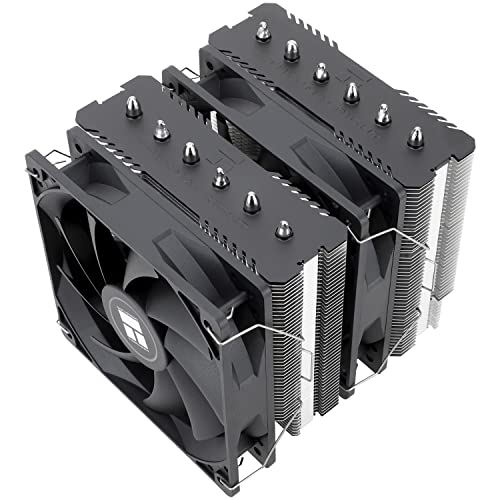 Thermalright Peerless Assassin 120 SE CPU Cooler Thermalright Peerless Assassin 120 SE CPU Cooler | [Brand Overview] Thermalright is a Taiwan brand with… [Product specification] Thermalright PA120 SE 【2 PWM Fans】TL-C12C | Check price |
 DIYhz Water Cooling Computer Radiator DIYhz Water Cooling Computer Radiator | ★ Product Name: Water Cooling Radiator ★ Fan Installation Size: 120x120(This product does not… ★ Efficiently pulling heat away from cycling coolant… | Check price |
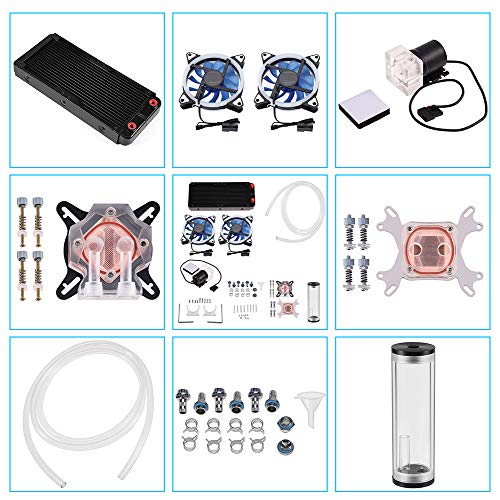 DIY 240mm Water Cooling Kit DIY 240mm Water Cooling Kit | 【Professional Water Cooling Kit】This liquid CPU cooler kit… 【High Performance】The CPU/GPU block is constructed with a… 【Super Water Circulation Cooling System】240mm Heat Sink: Provide… | Check price |
As an Amazon Associate we earn from qualifying purchases at no extra cost to you.
⚡ Save on Your Next PC — Amazon Prime
Prime members get fast free shipping on the systems above, plus early access to Prime Day & Black Friday PC deals. New members get a 30-day free trial.
Watch: Air vs Water Cooling for Gaming PCs — Video Review
Quick Verdict
For most gamers, a high-end air cooler like the Peerless Assassin 120 SE offers 90 percent of the cooling for a fraction of the price and zero pump to fail. For high-core or overclocked CPUs, or for a clean look with a big radiator, a 360mm AIO like the ARCTIC Liquid Freezer III Pro pulls ahead on peak thermals and clears space around the socket. Air wins on value and reliability; liquid wins on peak performance and aesthetics.
Key Differences
- Cooling ceiling: A 360mm AIO handles the hottest CPUs best; top air towers match smaller AIOs on mainstream chips.
- Reliability: Air has no pump or liquid to fail; AIOs add a moving part with a finite lifespan.
- Noise: Both can run quiet; large radiators move more air at lower fan speeds for a given heat load.
- Clearance: Big air towers can block tall RAM; AIOs free up space around the socket but need radiator mounting room.
- Price: Quality air coolers cost far less than comparable AIOs.
- Aesthetics: AIOs offer a cleaner look and RGB pump caps; air is more utilitarian.
Air Cooling
A modern dual-tower air cooler is a marvel of value. Units like the Thermalright Peerless Assassin 120 SE, with six heat pipes and dual 120mm fans, cool mainstream and even many high-end CPUs within a couple of degrees of a 240mm liquid cooler, at a fraction of the cost. There’s no pump to wear out, no liquid to evaporate, and nothing to leak, so an air cooler often outlives the rest of the build.
The downsides are size and looks. Big towers are tall and heavy, can obstruct tall RAM modules, and put a visible slab of metal over the socket. For the hottest overclocked chips they may run a few degrees warmer than a large AIO, but for the vast majority of gaming systems that gap is invisible in real use.
Water Cooling
An all-in-one liquid cooler moves heat to a radiator mounted at the top or front of the case, where more surface area and larger fans dissipate it efficiently. A 360mm unit like the ARCTIC Liquid Freezer III Pro gives the best sustained thermals for high-core-count or overclocked CPUs and keeps the area around the socket clear, which many builders prefer for airflow and looks. Custom loops, built from parts like fittings kits and DIY radiators, take this further for enthusiasts.
The tradeoffs are cost, complexity, and the pump. AIOs cost more, add a component that can eventually fail, and need adequate radiator mounting space. Custom loops demand real time and skill. For a mainstream gamer, a big AIO is a want rather than a need, but it’s a satisfying one.
Which Should You Buy?
- Buy air if: You want the best value and maximum reliability with no pump to fail.
- Buy a 360mm AIO if: You run a hot, high-core, or overclocked CPU and want peak thermals.
- Buy air if: Your case is small or you want to spend the savings on a better GPU.
- Buy liquid if: You want a clean look, clear socket area, and RGB centerpiece.
- Check clearance first: Confirm RAM height for air, or radiator mounting space for an AIO, before buying.
Frequently Asked Questions
Is water cooling better than air cooling?
For the hottest CPUs and for aesthetics, a large AIO edges ahead. For mainstream gaming, a top air cooler matches most AIOs while costing less and never risking a pump failure.
Do AIO coolers leak?
Quality sealed AIOs rarely leak, but the risk is non-zero and the pump has a finite lifespan of several years. Air coolers eliminate both concerns entirely.
Will a big air cooler block my RAM?
It can. Tall dual-tower coolers may overhang the first RAM slot, so check the cooler’s RAM clearance spec against your memory height, or choose low-profile RAM.
What radiator size do I need?
A 240mm AIO suits mainstream CPUs, while 360mm is better for high-core or overclocked chips. Match the radiator to a case that supports its mounting length.
Final Verdict
Both cooling paths work; the smart choice depends on your priorities. Pick a premium air tower like the Peerless Assassin for unbeatable value and worry-free reliability, or a 360mm AIO like the ARCTIC Liquid Freezer III Pro for peak thermals on a hot chip and a cleaner build. Check your clearances, and either way your CPU will stay comfortably below throttling limits.