Key takeaways
- Choose an opening of roughly 7–10 cm when easy hand cleaning matters.
- Prefer a smooth interior without etched lettering or decorative grooves.
- Rinse promptly after use; do not let wine sit overnight.
- Use warm water and a small amount of unscented detergent rather than abrasive powders.
- Dry upside down only if the neck is supported and air can circulate; otherwise use a decanter stand.
- Do not pour boiling water into a cold decanter, since thermal shock can crack glass or crystal.
The best decanter depends on whether you prioritize fast aeration, controlled pouring, easy cleaning, or resistance to chips: choose a broad 1.5–2 liter wine decanter for young red wine, a narrow-neck 0.75–1 liter decanter for spirits, and lead-free crystal or durable machine-made crystal when you want a lighter, tougher upgrade over ordinary glass.
Best decanters by use case
| Situation | Best shape and material | Useful capacity | Why it fits |
|---|---|---|---|
| Young, tannic red wine | Wide-bowl wine decanter with a broad base | 1.5–2.0 L | Maximizes wine-to-air contact and leaves room for swirling |
| Older red wine with sediment | Narrower decanter with a long neck and steady pour | 0.75–1.0 L | Encourages a slow pour without excessively exposing fragile wine to air |
| Whisky, brandy, or rum storage | Stoppered square or cylindrical decanter with a tight glass or synthetic seal | 0.75–1.0 L | Controls evaporation and looks polished on a bar or sideboard |
| Frequent entertaining | Machine-made lead-free crystal with a stable base | 1.0–1.5 L | Offers clarity and durability without the fragility of very thin hand-blown glass |
| Small apartment or crowded bar cart | Compact cylindrical decanter, preferably under 25 cm tall | 0.5–0.75 L | Uses less counter space and is easier to store safely |
Glass versus crystal: the practical difference
Ordinary soda-lime glass is usually the sensible choice when cost, chip resistance, and everyday replacement matter most. It can be slightly heavier and less brilliant than crystal, but a well-made glass decanter still gives wine plenty of useful aeration. It is also less painful to replace if a guest knocks it against a sink or bar top. Basic glass decanters commonly cost about $25–$70.
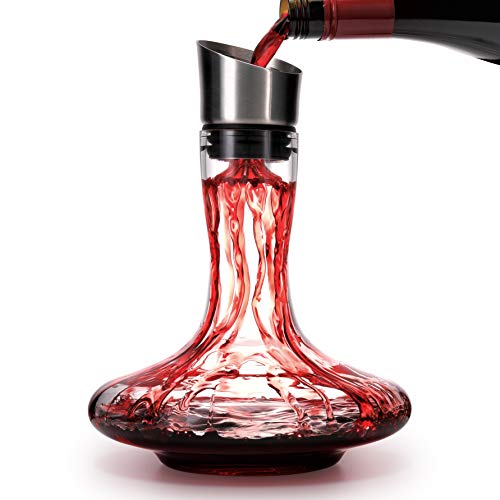
Wine Decanter Built-in Aerator, 750ml Red Wine Decanter Carafe with Aerator
Included for 'Best Decanters for Wine and Spirits' because the listing specifies 750ml Red Wine Decanter Carafe with Aerator, details this guide uses to compare options.
View on Amazon
Le Chateau Large Elegant Crystal Wine Decanter with Built-in Aerator
Included for 'Best Decanters for Wine and Spirits' as a relevant option in this category; details come from the product listing.
View on Amazon
Bormioli Rocco Selecta Collection Whiskey Decanter – Sophisticated 33.75oz Diamond Decanter With Starburst Detailing – For Whiskey, Bourbon, Scotch & Liquor
Included for 'Best Decanters for Wine and Spirits' because the listing specifies For Whiskey and Bourbon, details this guide uses to compare options.
View on Amazon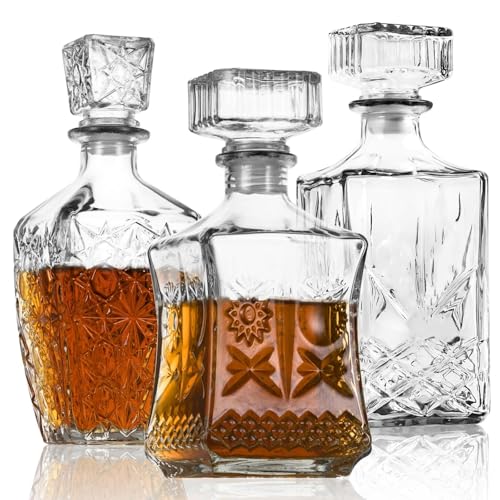
LAWADACH Whiskey Decanter Set of 3, Glass Alcohol Bottle Gift for Men, Dad
Included for 'Best Decanters for Wine and Spirits' because the listing specifies Glass Alcohol Bottle Gift for Men and Dad, details this guide uses to compare options.
View on AmazonLead-free crystal is typically clearer, thinner, and more resonant than standard glass. Its main benefit is not that it magically improves flavor; it allows manufacturers to make a lighter vessel with a refined rim and attractive optical clarity. Machine-made lead-free crystal is often the best balance for regular use, generally costing $50–$150.
Hand-blown crystal can have thinner walls, unusual shapes, and a more carefully finished lip. However, the thinness that makes it elegant can make the rim and stopper more vulnerable to impact. Some premium decanters cost $150–$500 or more. Leaded crystal may be beautiful and heavy, but it is less convenient for frequent wine or spirit storage because prolonged contact with acidic liquids is best avoided. For most buyers, lead-free crystal is the simpler choice.
| Material | Typical wall and weight trade-off | Chip resistance | Cleaning reality | Typical market range |
|---|---|---|---|---|
| Standard glass | Moderately thick and often heavier | Good relative to thin crystal | Usually easier to handle; check whether the neck is narrow | $25–$70 |
| Machine-made lead-free crystal | Thinner, lighter, and highly clear | Moderate | Often dishwasher-compatible, but hand washing protects the finish | $50–$150 |
| Hand-blown lead-free crystal | Very light with a thin rim and more variation | Lower at the rim and stopper | Hand wash only is the safer assumption | $150–$500+ |
| Leaded crystal | Heavier with a distinctive sparkle | Moderate, but edges can still chip | Hand wash and avoid long-term liquid storage | $100–$500+ |
Capacity: do not confuse bottle size with usable volume
A standard wine bottle holds 750 milliliters, but a decanter should not be filled to its rim. Leave roughly 20–30% of the vessel empty so you can pour without splashing and swirl wine without sending it over the edge. A 1.5-liter decanter is therefore a comfortable size for one bottle, while a 1-liter model may feel cramped once the wine is poured.
For two bottles, look for at least 2 liters of total capacity and a base wide enough to remain stable when full. Remember that a full 1.5-liter decanter containing wine may weigh around 1.8–2.4 kilograms once the vessel itself is included. A narrow side table or lightweight bar cart should not be treated as automatically suitable.
For whisky and other spirits, capacity is more about headspace and storage than aeration. A 750-milliliter bottle fits comfortably in a 0.75–1-liter decanter. Larger 1.5-liter designs can look impressive but take up more room and create a larger air space if only partly filled.
Shape determines aeration and pour control
Wide bowls: fastest aeration
A wide bowl with a broad base exposes more wine to air. This is useful for young Cabernet Sauvignon, Syrah, Nebbiolo, and other structured reds that may taste tight immediately after opening. The trade-off is cleaning: broad bowls often have an awkward shoulder, and their large footprint makes them easier to bump.
Narrow necks: slower, cleaner pouring
A narrow neck gives you better control when serving and is preferable for older wine with sediment. Hold the bottle or decanter at a shallow angle and pour slowly, stopping when sediment approaches the shoulder. A long neck also reduces spills when serving at a crowded dining table, but it makes brushes and drying more important.
Angled spouts and collars: useful but not magic
An angled pouring lip can reduce drips, especially when the rim has a sharp, well-formed edge. A removable collar or integrated pourer may improve control, but it adds another part to clean. Avoid selecting a decanter solely because its shape looks aggressively aerodynamic: a stable base and a smooth rim matter more in daily use.
Stoppered spirit decanters
A stopper helps limit dust and slows evaporation, but it does not make an imperfect seal airtight. For spirits kept for months, check that the stopper sits evenly and that its seal is made from a material intended for alcohol contact. A decorative loose-fitting stopper is fine for serving but not ideal for long-term storage.
Cleaning difficulty is a buying criterion
The hardest decanters to clean have a wide body, narrow neck, sharply curved shoulder, and no dishwasher guidance. Wine residue can dry into a film at the bottom, while lipstick and oily spirit residue collect around the rim. If you cannot comfortably fit your hand or a suitable brush through the opening, expect to use decanter-cleaning beads, warm water, and extra drying time.
- Choose an opening of roughly 7–10 cm when easy hand cleaning matters.
- Prefer a smooth interior without etched lettering or decorative grooves.
- Rinse promptly after use; do not let wine sit overnight.
- Use warm water and a small amount of unscented detergent rather than abrasive powders.
- Dry upside down only if the neck is supported and air can circulate; otherwise use a decanter stand.
- Do not pour boiling water into a cold decanter, since thermal shock can crack glass or crystal.
Dishwasher compatibility varies by model, even within the same brand. Schott Zwiesel and Spiegelau make machine-made lead-free crystal ranges, while RIEDEL offers both machine-made and hand-finished lines; always follow the specific care instructions rather than assuming every decanter from a brand has the same tolerance. Premium hand-blown pieces from brands such as Waterford are generally safer to hand wash.
Decanter dimensions and furniture fit
Before buying, measure the shelf, bar cart, or dining table rather than relying on capacity alone. Many full-size wine decanters stand about 20–30 cm tall and occupy 20–30 cm of table depth. Leave at least 5 cm of clear space around the base so a hand can grip it without knocking glasses. On a bar cart, keep the decanter’s center of mass over the cart’s inner frame and avoid placing it on a top shelf with less than 35 cm of vertical clearance.
A filled decanter should sit on a rigid, level surface. Thin console tables, folding trays, and narrow shelves may flex when a heavy vessel is set down. For homes with children or pets, a low coffee table is a poor location; use a rear section of a stable sideboard, ideally away from the edge and from passing tails, bags, and sleeves.
What to choose for common household situations
| Your priority | Recommended choice | What to avoid |
|---|---|---|
| Kids or pets | Thick-walled glass, broad stable base, no fragile stopper | Tall narrow-neck crystal with a loose top |
| Renting or moving often | One compact 1-liter machine-made crystal or glass decanter | A heavy decorative set that needs a dedicated cabinet |
| Small apartment | 0.75–1-liter cylindrical design under 25 cm tall | Oversized 2-liter bowl that consumes most of a table |
| Frequent red-wine service | 1.5-liter wide-base decanter with a comfortable grip | Extremely thin hand-blown walls |
| Back or hand-strength concerns | Lightweight lead-free crystal or glass with a large neck | Heavy leaded crystal with a slippery, oversized stopper |
Bottom line
For most homes, the best decanter is a 1.5-liter, wide-base, lead-free crystal or sturdy glass model with a 7–10 cm opening and a stable footprint. Choose a narrower 0.75–1-liter design when pour control and spirit storage matter more than rapid aeration. Pay for hand-blown crystal only if the lighter construction, appearance, or craftsmanship is important to you; otherwise, durable machine-made crystal delivers the most useful combination of clarity, manageable weight, cleaning practicality, and everyday value.