Key takeaways
- Sensor quality over DPI numbers: Anything above 16,000 DPI is marketing. What matters is tracking consistency and low smoothing — proven optical sensors like Logitech’s HERO or Razer’s Focus line perform flawlessly at the 400–1,600 DPI most players actually use.
- Weight and shape for your grip: Palm grippers want a larger, filled-out shell around 95–105g; claw and fingertip players benefit from something under 85g. Measure your hand from wrist crease to middle fingertip and match it to the mouse’s length before ordering.
- Switch rating and feel: Look for main switches rated to at least 50 million clicks. Beyond longevity, test for pre-travel and crispness — spongy clicks are the most common corner cut in sub-$50 mice and the hardest to live with.
- Wired versus wireless trade-offs: Wireless under $50 is now viable, but you’ll typically trade RGB, extra buttons, or onboard memory to get there. If you play competitively and don’t mind a cable, wired gets you more features per dollar.
- Software and onboard profiles: Check whether DPI stages and button remaps save to the mouse itself. Onboard memory means your settings survive a PC swap or a LAN trip without installing bloated software on someone else’s machine.
Shopping for a gaming mouse under $50 is deceptively tricky. The budget tier is crowded with sensors that look impressive on a spec sheet — 26,000 DPI, 1,000 Hz polling — but paired with mushy main switches, cheap PTFE feet, or cables stiff enough to fight you mid-flick. Meanwhile, genuinely good mice occasionally dip into this range on sale, so the difference between a smart purchase and a regrettable one often comes down to timing and knowing which specs actually matter.
This guide covers the gaming mice we’d actually recommend at or near $50 in 2026, spanning wired and wireless, lightweight and feature-loaded. We’ve focused on models with proven sensors, switch durability that holds up past the warranty period, and shapes that suit real hand sizes rather than marketing renders. Below you’ll find our picks, a short buying framework, and answers to the questions we get asked most.
Our top picks




As an Amazon Associate we earn from qualifying purchases at no extra cost to you. Ratings are shown as listed on Amazon.
⚡ Save on Your Next PC — Amazon Prime
Prime members get fast free shipping on the systems above, plus early access to Prime Day & Black Friday PC deals. New members get a 30-day free trial.
Watch: Best Gaming Mouse Under $50 — Video Review
How to Choose Gaming Mouse Under $50
- Sensor quality over DPI numbers: Anything above 16,000 DPI is marketing. What matters is tracking consistency and low smoothing — proven optical sensors like Logitech’s HERO or Razer’s Focus line perform flawlessly at the 400–1,600 DPI most players actually use.
- Weight and shape for your grip: Palm grippers want a larger, filled-out shell around 95–105g; claw and fingertip players benefit from something under 85g. Measure your hand from wrist crease to middle fingertip and match it to the mouse’s length before ordering.
- Switch rating and feel: Look for main switches rated to at least 50 million clicks. Beyond longevity, test for pre-travel and crispness — spongy clicks are the most common corner cut in sub-$50 mice and the hardest to live with.
- Wired versus wireless trade-offs: Wireless under $50 is now viable, but you’ll typically trade RGB, extra buttons, or onboard memory to get there. If you play competitively and don’t mind a cable, wired gets you more features per dollar.
- Software and onboard profiles: Check whether DPI stages and button remaps save to the mouse itself. Onboard memory means your settings survive a PC swap or a LAN trip without installing bloated software on someone else’s machine.
The Best Picks Reviewed
Logitech G305 Lightspeed
The G305 remains the reference point for affordable wireless: Logitech’s Lightspeed connection is genuinely indistinguishable from wired in blind testing, and the HERO sensor tracks cleanly across the full DPI range. At around 99g with the AA battery installed it isn’t light by 2026 standards, but 250 hours of runtime and rock-solid reliability make it an easy recommendation for anyone escaping cable drag on a budget.
Logitech G502 Hero
Eleven programmable buttons, adjustable weights, and a free-spin scroll wheel make the G502 the most feature-dense mouse on this list — it’s the obvious pick for MMO, sim, and strategy players who want macros within thumb reach. It’s chunky and heavy at 121g before weights, so claw grippers and low-sensitivity FPS players should look elsewhere, but for its intended audience nothing under $50 matches it.
Redragon M612 Predator
The M612 is the value play: 8,000 DPI, seven remappable buttons, RGB lighting, and a comfortable ergonomic shell for roughly half the price of the name brands. The sensor and switches don’t match Logitech or Razer under close scrutiny, but for a secondary rig, a first gaming mouse, or a build where every dollar counts elsewhere, it punches well above its cost.
Razer Basilisk V3
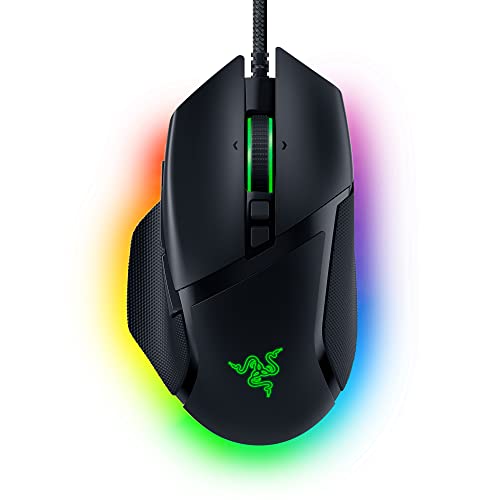
Razer’s Basilisk V3 pairs an excellent ergonomic right-handed shell with a tilt-click scroll wheel that switches between tactile and free-spin modes on the fly — genuinely useful for anyone who alternates between games and long documents. Eleven programmable inputs and 11 RGB zones round it out, and it frequently sits at or just under $50 during sales, which is where it becomes a standout.
Razer DeathAdder Essential
The DeathAdder shape has sold tens of millions of units for a reason: it’s the safest large-palm-grip ergonomic design in gaming, and the Essential strips it back to a 6,400 DPI optical sensor and five buttons to hit a budget price. There’s no wireless, minimal RGB, and no frills — just a comfortable, dependable mouse that consistently sells for well under $50.
Frequently Asked Questions
Is a wireless gaming mouse under $50 actually good enough for competitive play?
Yes. Modern low-latency wireless like Logitech’s Lightspeed adds roughly 1ms over a wired connection — far below human perception thresholds. The real compromises at this price are weight and feature count, not responsiveness.
Does higher DPI make me a better player?
No. The vast majority of competitive players use 400–1,600 DPI, and sensors have tracked flawlessly in that range for over a decade. High DPI ceilings are a spec-sheet talking point, not a performance advantage.
How long should a sub-$50 gaming mouse last?
With switches rated to 50–70 million clicks, expect three to five years of daily gaming from a reputable model. Cables and mouse feet usually fail before the switches do, and both are cheap to replace or work around.
Do I need to install the manufacturer’s software?
Only for initial configuration if the mouse has onboard memory. Set your DPI stages, polling rate, and button binds, save them to the device, then uninstall the software if you’d rather not have it running in the background.
Final Thoughts
For most players, the Logitech G305 Lightspeed is the smartest buy under $50 — reliable wireless with a proven sensor and no meaningful performance compromise. If you’d rather trade the cable for features, the Logitech G502 Hero delivers an unmatched button count and customization for the money, while the Razer DeathAdder Essential remains the safest pick for anyone with larger hands who wants a comfortable, no-nonsense ergonomic shape at the lowest possible price.