Key takeaways
- Refresh rate over resolution: At this budget, 1080p at 144Hz will feel dramatically smoother in competitive games than 1440p at 60Hz. Only step up to QHD if you find a 100Hz-plus panel within budget, and be prepared for your GPU to work harder.
- Panel type matters more than the marketing: IPS gives you the best colour and viewing angles, VA delivers deeper blacks and better contrast for atmospheric single-player games, and TN is now largely reserved for the cheapest tier. Match the panel to the games you actually play.
- Adaptive sync is non-negotiable: AMD FreeSync or G-Sync Compatible support eliminates screen tearing without the input lag penalty of V-Sync. Nearly every monitor here supports it, so there is no reason to buy one that does not.
- Check the ports before you buy: DisplayPort is required to reach maximum refresh rates on many budget panels; HDMI is often capped lower. If you are running a console alongside a PC, dual HDMI inputs will save you a lot of cable swapping.
- Ignore HDR claims under $200: Meaningful HDR requires local dimming and 600-plus nits of peak brightness, neither of which exists at this price. Treat any HDR badge here as a software checkbox, not a feature you are paying for.
Shopping for a gaming monitor under $200 is a minefield. The sub-$200 tier is where marketing language works hardest: panels advertised at “144Hz” that only hit that refresh rate at reduced resolution, “HDR” badges on displays with 250 nits of brightness, and response-time figures measured under conditions you will never replicate at your desk. Meanwhile, the specs that actually determine whether a monitor feels good to play on — panel type, real motion clarity, adaptive sync support, and connector selection — are often buried at the bottom of the listing.
This guide cuts through that. We have focused on displays that deliver genuine value at this price, covering 22-inch 144Hz budget options for competitive shooters, larger 27-inch panels for immersion, and one curved pick for sim and single-player fans. Every recommendation below realistically lands under $200 at typical street pricing, and we have flagged where a monitor makes a sensible compromise versus where it cuts a corner you will regret.
Our top picks


As an Amazon Associate we earn from qualifying purchases at no extra cost to you. Ratings are shown as listed on Amazon.
⚡ Save on Your Next PC — Amazon Prime
Prime members get fast free shipping on the systems above, plus early access to Prime Day & Black Friday PC deals. New members get a 30-day free trial.
Watch: Best Gaming Monitor Under $200 — Video Review
How to Choose Gaming Monitor Under $200
- Refresh rate over resolution: At this budget, 1080p at 144Hz will feel dramatically smoother in competitive games than 1440p at 60Hz. Only step up to QHD if you find a 100Hz-plus panel within budget, and be prepared for your GPU to work harder.
- Panel type matters more than the marketing: IPS gives you the best colour and viewing angles, VA delivers deeper blacks and better contrast for atmospheric single-player games, and TN is now largely reserved for the cheapest tier. Match the panel to the games you actually play.
- Adaptive sync is non-negotiable: AMD FreeSync or G-Sync Compatible support eliminates screen tearing without the input lag penalty of V-Sync. Nearly every monitor here supports it, so there is no reason to buy one that does not.
- Check the ports before you buy: DisplayPort is required to reach maximum refresh rates on many budget panels; HDMI is often capped lower. If you are running a console alongside a PC, dual HDMI inputs will save you a lot of cable swapping.
- Ignore HDR claims under $200: Meaningful HDR requires local dimming and 600-plus nits of peak brightness, neither of which exists at this price. Treat any HDR badge here as a software checkbox, not a feature you are paying for.
The Best Picks Reviewed
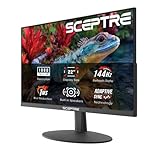
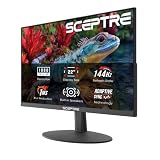
Sceptre 22-Inch 144Hz (E225W-FW144)
This is the most sensible entry point into high-refresh gaming, pairing a genuine 144Hz 1080p panel with both HDMI and DisplayPort so you can actually reach that refresh rate out of the box. The 22-inch size keeps pixel density tight and the whole screen within your field of view, which is exactly what you want for competitive shooters — just do not expect much from the built-in speakers.
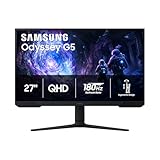
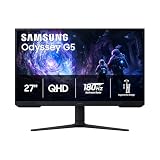
Samsung 27″ Odyssey G5 (G51F)
The standout value pick if you can find it at the lower end of its pricing range: a 27-inch QHD panel from a major manufacturer, with the resolution and screen real estate to make strategy games, RPGs and general desktop work feel genuinely spacious. You will need a mid-range GPU to drive 1440p properly, so this is the choice for players upgrading a capable system rather than building on a shoestring.
ArcticPro 22-Inch 144Hz
A direct rival to the Sceptre 22-inch, distinguished by its 105% sRGB coverage, which means colours look noticeably richer than the washed-out output typical of the cheapest budget panels. It is a strong pick if you edit photos or watch as much content as you game, though the brand carries less of a service-and-support track record than the established names.
Sceptre 27-inch Prime (E275W-FW100T)
At 27 inches with 100Hz, 100% sRGB coverage and FreeSync, this is the immersion-first option: bigger and more colour-accurate than the 22-inch models, at the cost of 44Hz of refresh rate. The dual HDMI ports plus DisplayPort make it a practical hub if you are switching between a PC and a console.
Philips 22-Inch VA (221V8LB)
The VA panel here delivers the deepest blacks of any monitor on this list, which pays off in horror games, space sims and anything with heavy shadow detail. At 100Hz it is not built for competitive play, but the flicker-free backlight and Philips build quality make it the pick for long sessions and mixed work-and-play use.
Frequently Asked Questions
Is 144Hz worth it over 60Hz at this budget?
Absolutely — it is the single most noticeable upgrade you can make under $200. The improvement in motion clarity and responsiveness is immediately obvious in any fast-paced game, and unlike a resolution jump, it costs your GPU comparatively little.
Can I game at 1440p on a sub-$200 monitor?
You can, and the Odyssey G5 proves it, but the monitor is only half the equation. Running 1440p at high frame rates needs a reasonably modern mid-range graphics card; on older hardware you may be better served by a faster 1080p panel.
Do I need DisplayPort, or will HDMI do?
For 1080p at 144Hz, DisplayPort is the safer choice, as some budget monitors limit HDMI to 60Hz or 120Hz. Check the specification sheet rather than assuming, and use the cable supplied in the box where possible.
Are built-in speakers good enough for gaming?
No. The speakers included on budget monitors are thin, quiet and lacking in bass — treat them as a fallback for video calls rather than a substitute for headphones or desktop speakers.
Final Thoughts
For most players, the Sceptre 22-Inch 144Hz is the smartest buy on this list: it puts your money into the refresh rate that actually changes how games feel. If you have a capable GPU and want screen real estate over raw speed, the Samsung Odyssey G5 (G51F) is remarkable value for a 27-inch QHD panel, while the Philips 221V8LB is the one to pick if contrast and comfortable all-day use matter more to you than frame rates.