Key takeaways
- Refresh rate over resolution: At this budget, 1080p at 144Hz beats 1440p at 60Hz for competitive play. Smooth motion is more noticeable than extra pixels on a 24-inch screen, and your GPU will thank you.
- Panel type matters more than “1ms”: IPS gives you accurate colour and wide viewing angles; TN is faster but washed out; VA sits between with better contrast and occasional dark smearing. Most sub-$300 response-time claims are measured with aggressive overdrive, so treat them as marketing, not spec.
- Check adaptive sync compatibility: FreeSync is near-universal now, but confirm G-Sync Compatible certification if you run an NVIDIA card. Without it, you’ll see tearing whenever your framerate dips below the refresh ceiling.
- Size to your desk distance: 24 inches is the competitive sweet spot at typical desk depth — you can track the whole screen without eye movement. Jump to 27 inches only if you sit further back, since 1080p pixel density drops noticeably.
- Don’t pay for HDR at this price: “HDR10 support” on a sub-$300 monitor means it accepts an HDR signal, not that it can display one meaningfully. Budget for peak brightness and contrast instead, and leave HDR off in games.
Shopping for a gaming monitor under $300 in 2026 sounds easy until you actually start looking. Spec sheets are crowded with overclocked refresh rates, “1ms” figures measured three different ways, and HDR badges that mean almost nothing at this price. The result is a market where a $120 panel and a $280 panel can look identical on paper, and where the genuinely good value picks are easy to miss.
This guide cuts through that. We’ve focused on 1080p monitors between 22 and 27 inches with real 144Hz support, adaptive sync that works with both NVIDIA and AMD cards, and panel quality that holds up outside of benchmarks. Every recommendation below sits comfortably under $300 — most sit well under it — and we’ve been explicit about where each one compromises, because at this budget every monitor compromises somewhere.
Our top picks




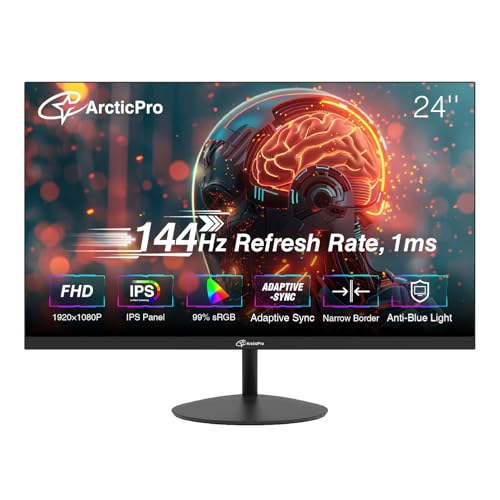

As an Amazon Associate we earn from qualifying purchases at no extra cost to you. Ratings are shown as listed on Amazon.
⚡ Save on Your Next PC — Amazon Prime
Prime members get fast free shipping on the systems above, plus early access to Prime Day & Black Friday PC deals. New members get a 30-day free trial.
Watch: Best Gaming Monitor Under $300 — Video Review
How to Choose Gaming Monitor Under $300
- Refresh rate over resolution: At this budget, 1080p at 144Hz beats 1440p at 60Hz for competitive play. Smooth motion is more noticeable than extra pixels on a 24-inch screen, and your GPU will thank you.
- Panel type matters more than “1ms”: IPS gives you accurate colour and wide viewing angles; TN is faster but washed out; VA sits between with better contrast and occasional dark smearing. Most sub-$300 response-time claims are measured with aggressive overdrive, so treat them as marketing, not spec.
- Check adaptive sync compatibility: FreeSync is near-universal now, but confirm G-Sync Compatible certification if you run an NVIDIA card. Without it, you’ll see tearing whenever your framerate dips below the refresh ceiling.
- Size to your desk distance: 24 inches is the competitive sweet spot at typical desk depth — you can track the whole screen without eye movement. Jump to 27 inches only if you sit further back, since 1080p pixel density drops noticeably.
- Don’t pay for HDR at this price: “HDR10 support” on a sub-$300 monitor means it accepts an HDR signal, not that it can display one meaningfully. Budget for peak brightness and contrast instead, and leave HDR off in games.
The Best Picks Reviewed
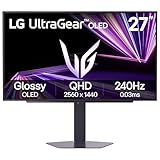
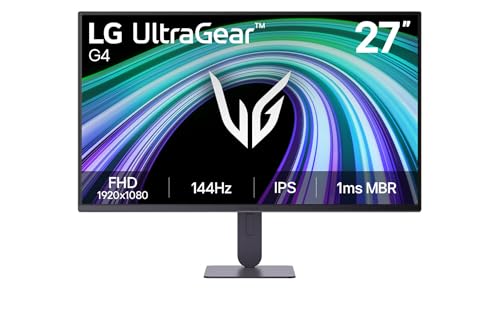
LG 27G414B-B UltraGear 27-inch
This is the most complete package on the list: a 27-inch IPS panel at 144Hz with G-Sync Compatible certification, built-in speakers, and — unusually at this price — a height-adjustable stand rather than tilt-only. Pixel density is the tradeoff at 1080p across 27 inches, but if you sit a normal desk distance back, the extra screen real estate is worth it.
ASUS TUF Gaming VG249QE5A 24-inch
ASUS has quietly made this the default recommendation for competitive players on a budget, and it earns it: a fast IPS panel, 146Hz overclock, Extreme Low Motion Blur Sync, and variable overdrive that actually reduces overshoot instead of trading one artefact for another. The three-year warranty is genuinely rare in this bracket and worth factoring into the value calculation.
LG 24G411A-B UltraGear 24-inch
Essentially the 27-inch model’s smaller sibling, and arguably the better buy for pure competitive gaming — the tighter pixel pitch makes 1080p look noticeably sharper at 24 inches. You lose the height-adjustable stand and speakers, so budget for a VESA arm if ergonomics matter to you.
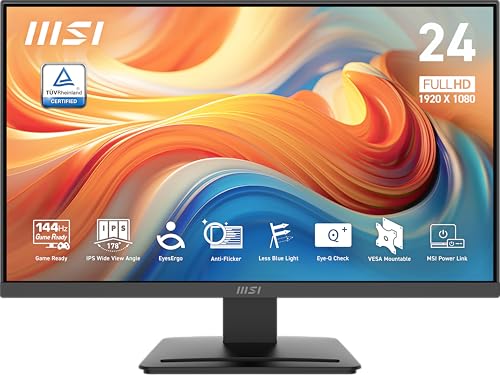
MSI PRO MP243L E14 24-inch
The best pick for anyone splitting time between gaming and work: a 144Hz IPS panel with slim four-side bezels for multi-monitor setups, plus a legacy VGA input that’s still useful for older office hardware. It’s a more conservative monitor than the LG or ASUS options — no G-Sync certification, no motion blur reduction — but it’s dependable and typically the cheapest 24-inch IPS here.
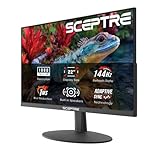
Sceptre E225W-FW144 22-inch
The entry point. At 22 inches and 144Hz with both HDMI and DisplayPort plus built-in speakers, it’s the cheapest realistic route to high-refresh gaming, and a sensible choice for a secondary desk, a dorm room, or a first build. Expect a noticeable step down in colour accuracy and viewing angles compared to the IPS panels above.
Frequently Asked Questions
Is 1080p still worth buying in 2026?
For gaming under $300, yes. A 1080p 144Hz monitor paired with a mid-range GPU gives you consistently high framerates, whereas a budget 1440p panel will force you to drop settings or accept a lower refresh rate. Move to 1440p when your GPU budget moves too.
Do I need 144Hz if my GPU can’t hit 144fps?
You’ll still benefit. Higher refresh rates reduce input latency and motion blur even at 90 or 100fps, and adaptive sync smooths out the variance. It’s one of the few upgrades that improves the experience immediately, regardless of framerate.
Will FreeSync monitors work with an NVIDIA graphics card?
Usually, but not always reliably. Monitors with explicit G-Sync Compatible certification — like both LG UltraGear models here — have been validated by NVIDIA and will work without flickering or dropout. Uncertified FreeSync panels often work fine, but you’re rolling the dice.
Are built-in speakers worth paying extra for?
Treat them as a convenience, not a feature. Monitor speakers at this price are thin and quiet, useful for system sounds or a background video, but no substitute for headphones or desktop speakers in games.
Final Thoughts
If you want one monitor that does everything well, the LG 27G414B-B UltraGear is the strongest all-rounder here, with the ergonomic stand and screen size to justify its position at the top of the budget. Competitive players focused purely on motion clarity should take the ASUS TUF VG249QE5A instead — the variable overdrive and three-year warranty make it the smartest value on the list. And if you simply want 144Hz gaming for as little as possible, the Sceptre E225W-FW144 gets you there with a compromise you can live with.