Key takeaways
- Contrast and black levels: OLED pixels switch off completely for true blacks and effectively infinite contrast; IPS relies on a backlight, so dark scenes show grey haze and visible “IPS glow” in corners.
- Motion clarity: OLED response times sit at 0.03ms GtG across the board, eliminating smearing entirely. Fast IPS has improved to roughly 1ms but still shows mild overshoot and blur during fast pans.
- Brightness in real rooms: Good IPS panels sustain 350–450 nits full-screen; OLED excels in small-highlight peaks but drops in full-field brightness, which matters if you sit near a window.
- Burn-in and longevity: IPS carries zero burn-in risk. OLED mitigates it with pixel refresh, logo dimming, and heatsinks — the Odyssey G6 ships with OLED Safeguard and a 3-year warranty covering it.
- Text and desktop use: IPS uses a standard RGB stripe for crisp text. QD-OLED’s triangular subpixel layout can cause slight colour fringing, though 2026 panels and Windows tuning have reduced it substantially.
- Price per hertz: IPS still delivers more refresh rate per dollar, with 300Hz+ 1440p models undercutting most OLEDs.
Choosing between OLED and IPS used to be simple: OLED was the aspirational splurge, IPS was the sensible buy. In 2026 that gap has narrowed to the point where a 27-inch 1440p QD-OLED can sit in the same shopping cart as a high-refresh Fast IPS panel. Third-generation QD-OLED and WOLED panels have pushed brightness higher, cut burn-in risk with better pixel-shift and heatsink designs, and landed at price points that genuinely compete with premium IPS displays.
That makes the decision less about budget and more about how you actually play. Motion clarity, black levels, peak brightness in a sunlit room, text sharpness during a workday, and long-term panel confidence all pull in different directions. Below we break down where each panel technology wins, which specific monitors are worth your money right now, and how to match the panel to the way you game.
Our top picks


As an Amazon Associate we earn from qualifying purchases at no extra cost to you. Ratings are shown as listed on Amazon.
⚡ Save on Your Next PC — Amazon Prime
Prime members get fast free shipping on the systems above, plus early access to Prime Day & Black Friday PC deals. New members get a 30-day free trial.
Watch: OLED vs IPS Gaming Monitor: 2026 Comparison — Video Review
Quick Verdict
OLED is the better pick for anyone who plays story-driven games, values HDR impact, or wants the fastest motion clarity money can buy — the Samsung Odyssey OLED G6 and LG 27GX700A-B are the standouts at 240Hz and 280Hz respectively. IPS remains the smarter buy if you game in a bright room, spend all day in spreadsheets and code, need maximum refresh rate per dollar, or simply don’t want to think about burn-in ever again.
Key Differences
- Contrast and black levels: OLED pixels switch off completely for true blacks and effectively infinite contrast; IPS relies on a backlight, so dark scenes show grey haze and visible “IPS glow” in corners.
- Motion clarity: OLED response times sit at 0.03ms GtG across the board, eliminating smearing entirely. Fast IPS has improved to roughly 1ms but still shows mild overshoot and blur during fast pans.
- Brightness in real rooms: Good IPS panels sustain 350–450 nits full-screen; OLED excels in small-highlight peaks but drops in full-field brightness, which matters if you sit near a window.
- Burn-in and longevity: IPS carries zero burn-in risk. OLED mitigates it with pixel refresh, logo dimming, and heatsinks — the Odyssey G6 ships with OLED Safeguard and a 3-year warranty covering it.
- Text and desktop use: IPS uses a standard RGB stripe for crisp text. QD-OLED’s triangular subpixel layout can cause slight colour fringing, though 2026 panels and Windows tuning have reduced it substantially.
- Price per hertz: IPS still delivers more refresh rate per dollar, with 300Hz+ 1440p models undercutting most OLEDs.
OLED Gaming Monitors: Contrast and Speed Without Compromise
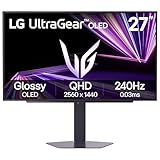
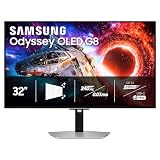
The 27-inch 1440p OLED class is where the value is concentrated. The LG 27GX700A-B leads on raw speed at 280Hz with G-Sync, FreeSync Premium Pro and DisplayHDR TrueBlack 500, plus 99.5% DCI-P3 coverage — it’s the best all-rounder for players who want esports pace and cinematic HDR in one panel. Its sibling, the 27GX704A-B, trims to 240Hz and TrueBlack 400 for a lower entry price while keeping HDMI 2.1 and the same 0.03ms response. The Samsung Odyssey OLED G6 counters with a glare-free matte coating, Pantone validation and a height-adjustable stand, making it the most practical choice for mixed work-and-play desks.
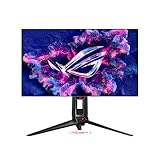
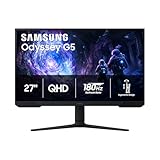
If you prefer the punchier look of a glossy finish, the ASUS ROG XG27AQDMG pairs a custom heatsink and anti-flicker circuitry with uniform brightness control and console-friendly compatibility for PS5 and Xbox. On a tighter budget, the Samsung Odyssey OLED G5 (G50SF) delivers the same QD-OLED contrast at 180Hz — plenty for single-player gaming. And for maximum immersion, the Alienware AW3425DW brings 34.2-inch WQHD ultrawide at 240Hz with a gentle 1800R curve that transforms sim racing and open-world titles.
IPS Gaming Monitors: Brightness, Durability and Value
Fast IPS hasn’t stood still. Current 1440p panels routinely hit 180Hz to 360Hz, cover 95%+ DCI-P3, and deliver near-perfect colour accuracy straight out of the box with excellent off-axis viewing. Crucially, they sustain high full-screen brightness indefinitely, so a bright living room or a south-facing office won’t wash out your game. There’s no automatic brightness limiter fighting you in HDR desktop use.
The bigger argument is peace of mind. An IPS panel can display a static HUD, taskbar or trading dashboard for eight hours a day for years with no degradation. For streamers, developers, and anyone whose monitor doubles as a work tool, that reliability plus the lower purchase price often outweighs OLED’s contrast advantage. The trade-off is dark-scene performance: black uniformity and shadow detail simply can’t match a self-emissive panel.
Which Should You Buy?
- For competitive shooters: pick the LG 27GX700A-B — 280Hz with 0.03ms response is the clearest motion available at 1440p.
- For single-player and HDR gaming: pick the Samsung Odyssey OLED G6 or ASUS ROG XG27AQDMG for reference-grade contrast and colour.
- For bright rooms and long work sessions: pick a high-refresh Fast IPS, or the matte, glare-free Odyssey G6 if you still want OLED.
- For immersion and sim racing: pick the Alienware AW3425DW ultrawide at 240Hz.
- For the best value entry into OLED: pick the Samsung Odyssey OLED G5 or the LG 27GX704A-B.
Frequently Asked Questions
Is OLED burn-in still a concern in 2026?
Far less than it was. Pixel-shifting, logo dimming, automatic pixel refresh cycles and custom heatsinks like the one in the ROG XG27AQDMG have made burn-in unlikely with normal mixed use. Samsung’s OLED Safeguard and a 3-year burn-in warranty cover the remaining risk.
Is 240Hz OLED better than 360Hz IPS?
Generally yes. OLED’s near-instant pixel transitions mean a 240Hz OLED often looks cleaner in motion than a faster IPS panel that still exhibits smearing and overshoot.
Do OLED monitors get bright enough for HDR?
For highlights, absolutely — DisplayHDR TrueBlack 400 and 500 certifications reflect genuinely impressive HDR thanks to perfect blacks. Full-screen white brightness is lower than IPS, which is only noticeable in very bright rooms.
Which is better for PS5 and Xbox Series X?
OLED, provided the monitor has HDMI 2.1 — both LG UltraGear models and the ASUS ROG XG27AQDMG support 120Hz console output with VRR and superb HDR.
Final Verdict
If gaming is your priority and your room isn’t flooded with light, OLED is now the clear recommendation — the LG 27GX700A-B and Samsung Odyssey OLED G6 deliver contrast and motion clarity that IPS can’t approach, at prices that no longer feel exotic. Choose IPS only if sustained brightness, static-content durability, or squeezing the most refresh rate out of a tight budget matters more to you than picture quality.