Key takeaways
- Cores and threads: The 9950X3D brings 16 cores and 32 threads across two CCDs; the 9800X3D is a single 8-core, 16-thread cluster. That’s roughly double the throughput in threaded workloads.
- Cache layout: The 9800X3D has V-Cache attached to its only CCD, so every core is a “fast” core. On the 9950X3D, one CCD carries the extra cache while the other chases higher clocks, and Windows scheduling decides which games land where.
- Clock speeds: The 9950X3D’s non-cache CCD reaches higher peak boost, which helps lightly threaded and productivity work. The 9800X3D counters with a higher sustained base clock on its cache die.
- Power and cooling: The 9800X3D is a 120W-class part that a solid air cooler handles comfortably. The 9950X3D is a 170W-class chip and genuinely wants a 280mm or 360mm AIO under sustained all-core load.
- Gaming return on investment: Across most engines the two land within a few percent of each other at 1440p and 4K. The 9950X3D’s premium buys productivity, not frames.
- Platform cost: Both drop into AM5. The 9800X3D is happy on a mid-range B850 board, while a 16-core chip is better served by the X870/X870E boards bundled in the Micro Center combos.
AMD’s 3D V-Cache lineup has been the default recommendation for gaming CPUs for so long that the real question is no longer “AMD or Intel” — it’s which X3D chip belongs in your build. In 2026 that decision comes down to two parts: the 16-core Ryzen 9 9950X3D and the 8-core Ryzen 7 9800X3D. Both sit on the same AM5 socket, both use DDR5, and both deliver the enormous L3 cache that makes 1% lows feel silky in CPU-bound titles.
The gap between them isn’t really about frame rates — it’s about everything you do around the game. Streaming, editing, compiling, running local AI models, or simply keeping 40 browser tabs and Discord alive while raiding all pull on core count. Choose wrong and you either pay for silicon you never touch, or you hit a wall the first time you export a 4K timeline. Here’s how the two actually differ, and which one deserves your money.
Our top picks


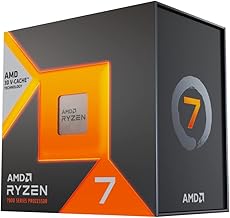
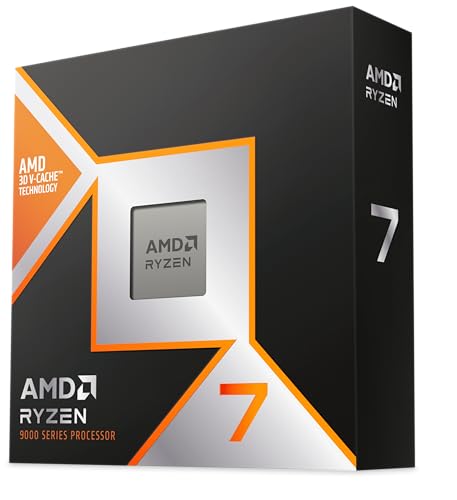 AMD RYZEN 7 9800X3D 8-Core
- Product Group: Personal Computer
- Binding: Personal Computers

As an Amazon Associate we earn from qualifying purchases at no extra cost to you. Ratings are shown as listed on Amazon.
⚡ Save on Your Next PC — Amazon Prime
Prime members get fast free shipping on the systems above, plus early access to Prime Day & Black Friday PC deals. New members get a 30-day free trial.
Watch: Ryzen 9 9950X3D vs 9800X3D: 2026 Showdown — Video Review
Quick Verdict
The Ryzen 7 9800X3D is the smarter buy for the vast majority of gamers: it matches or trades blows with its bigger sibling in most titles, runs cooler, and leaves budget for a better GPU — which is where your frames actually come from. The Ryzen 9 9950X3D is the pick if gaming is only half the job, and the other half is Blender, Premiere, Unreal shader compiles, VMs, or heavy multitasking. It’s a workstation chip that happens to game at flagship level.
Key Differences
- Cores and threads: The 9950X3D brings 16 cores and 32 threads across two CCDs; the 9800X3D is a single 8-core, 16-thread cluster. That’s roughly double the throughput in threaded workloads.
- Cache layout: The 9800X3D has V-Cache attached to its only CCD, so every core is a “fast” core. On the 9950X3D, one CCD carries the extra cache while the other chases higher clocks, and Windows scheduling decides which games land where.
- Clock speeds: The 9950X3D’s non-cache CCD reaches higher peak boost, which helps lightly threaded and productivity work. The 9800X3D counters with a higher sustained base clock on its cache die.
- Power and cooling: The 9800X3D is a 120W-class part that a solid air cooler handles comfortably. The 9950X3D is a 170W-class chip and genuinely wants a 280mm or 360mm AIO under sustained all-core load.
- Gaming return on investment: Across most engines the two land within a few percent of each other at 1440p and 4K. The 9950X3D’s premium buys productivity, not frames.
- Platform cost: Both drop into AM5. The 9800X3D is happy on a mid-range B850 board, while a 16-core chip is better served by the X870/X870E boards bundled in the Micro Center combos.
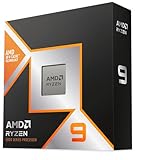
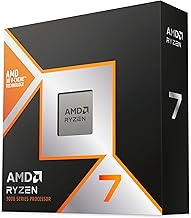
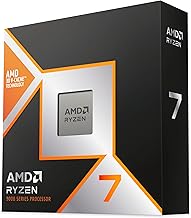
AMD Ryzen 9 9950X3D 16-Core Processor
The Ryzen 9 9950X3D is the closest thing to a no-compromise desktop CPU. Sixteen Zen 5 cores handle rendering, code compilation, multi-track audio, and local LLM inference at a level the 8-core parts simply can’t reach, and the stacked cache on the second CCD means it doesn’t concede gaming performance to do it. If you stream to Twitch with x264, run OBS scene-heavy overlays, or keep a game running while a project exports in the background, this is where the extra silicon earns its keep.
The tradeoff is complexity and heat. You’ll want current chipset drivers and firmware so games park correctly on the cache CCD, plus real cooling. Bundles like the 9950X3D with the GIGABYTE X870E AORUS Elite WIFI7 ICE, the Gigabyte X870 Gaming WF combo, or the MSI PRO X870E-P pairing take the guesswork out of VRM quality and PCIe 5.0 / USB4 support. There’s also the Ryzen 9 9950X3D2 Dual Edition for buyers who want V-Cache across both compute dies, and the cache-free Ryzen 9 9950X if your workload is pure productivity.
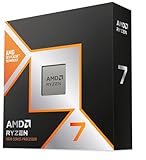
AMD Ryzen 7 9800X3D 8-Core Processor
The Ryzen 7 9800X3D remains the gaming CPU to beat. Because all eight cores share the V-Cache die, there’s no scheduler lottery and no CCD-crossing latency — you get consistent frametimes in exactly the games that punish weaker chips, like large-scale strategy titles, simulators, MMOs, and competitive shooters chasing 300+ fps at 1080p. It’s also the more forgiving build: lower power draw, a cooler chassis, and full compatibility with mainstream AM5 boards.
Its ceiling shows up outside games. Long video exports, big compiles, and heavy VM work take noticeably longer than on 16 cores, and if you stream with CPU encoding while playing something demanding, you’ll feel the squeeze sooner. For most people that’s an acceptable trade — the money saved on CPU, cooler, and motherboard is better spent on a stronger GPU, faster DDR5, or more storage.
Which Should You Buy?
- For pure gaming at any resolution: pick the 9800X3D — near-identical frames for meaningfully less money.
- For content creation plus gaming: pick the 9950X3D; 16 cores cut render and export times roughly in half.
- For streaming with CPU encoding: pick the 9950X3D, or stay on the 9800X3D if you offload to GPU NVENC/AV1.
- For a hassle-free, cool-running build: pick the 9800X3D and a good air cooler.
- For a one-box workstation: pick a 9950X3D motherboard combo, or the 9950X if cache-sensitive gaming isn’t a priority.
Frequently Asked Questions
Is the 9950X3D actually faster in games?
Sometimes, by a small margin, and occasionally slower depending on how a title is scheduled. Treat gaming performance as effectively tied and decide on productivity needs instead.
Do both use the same socket and memory?
Yes. Both are AM5 with dual-channel DDR5. A 6000 MT/s CL30 kit running EXPO remains the sweet spot for either chip.
What cooler do I need?
A quality dual-tower air cooler is fine for the 9800X3D. For the 9950X3D under sustained all-core load, a 280mm or 360mm AIO is strongly recommended.
Should I wait for the 9950X3D2 Dual Edition?
Only if your workload genuinely benefits from cache on both CCDs. For gaming, the standard parts already deliver the bulk of the performance available today.
Final Verdict
Buy the Ryzen 7 9800X3D if you play games and want the best value per frame — it’s still the smartest gaming CPU on AM5. Step up to the Ryzen 9 9950X3D, ideally as a motherboard combo, when your PC has a second job beyond gaming. Either way you’re on a socket with room to upgrade, which makes both of these safe long-term buys in 2026.